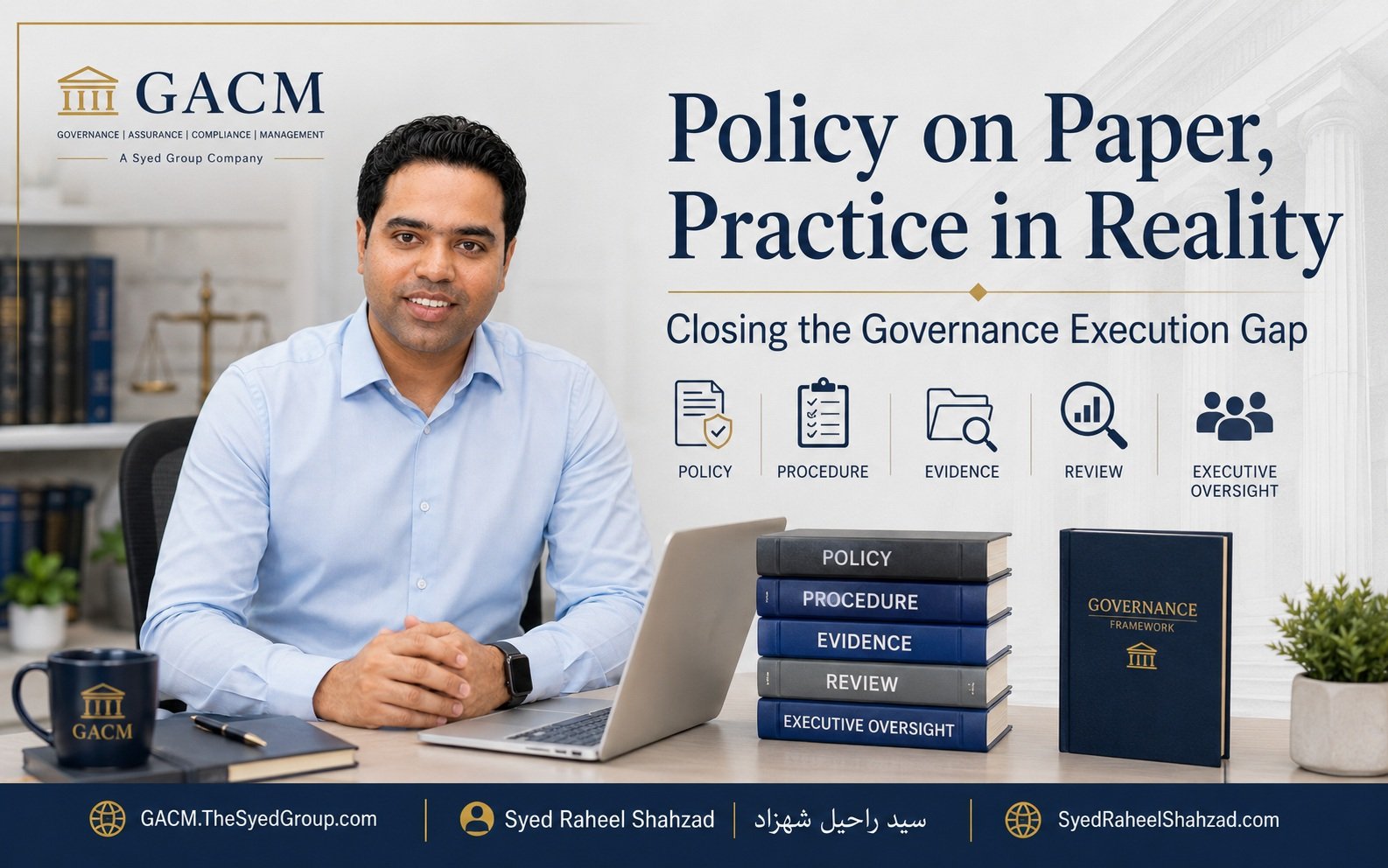
Policy on Paper, Practice in Reality: Closing the Governance Execution Gap
GACM explains how organisations can connect policies with procedures, ownership, evidence, exceptions and review to make governance work in practice.
A policy can exist without changing behaviour
Organisations often respond to risk by writing a policy. The document may be thoughtful, approved and professionally presented. Yet the organisation can continue operating almost exactly as before.
This happens because governance is not complete when a rule is written. The rule has to reach ordinary decisions, workflows, approvals, records and exceptions. If employees cannot explain how a policy affects their daily work, the policy may be institutionally present but operationally absent.
Policy answers what should happen
A policy establishes principles, boundaries and expectations. It might state how conflicts should be managed, how expenses should be approved or what standards apply to procurement.
That is necessary, but it is only the first layer. A policy without an operating mechanism leaves too much interpretation between the document and the decision.
Procedure answers how it should happen
The next layer translates principles into steps. Who initiates the process? Which evidence is required? Who reviews it? Who can approve? Where is the record stored? What happens if normal requirements cannot be followed?
These questions transform a principle into a repeatable process.
Evidence answers whether it actually happened
Governance becomes testable when the organisation can show evidence. That evidence might be an approval record, comparison sheet, signed declaration, meeting note, system log or other relevant document.
Without evidence, management may believe the procedure is being followed while having no reliable way to confirm it.
Exceptions are where governance is tested
Real organisations cannot operate without exceptions. Urgent purchases occur. Staff are absent. Systems fail. Unusual transactions appear. The question is not whether exceptions exist; it is whether they are visible, authorised and reviewed.
A strong governance system makes the exception process as clear as the normal process.
Review closes the loop
A control that worked last year may become ineffective after growth, restructuring or technology changes. Periodic review asks whether the policy still addresses the real risk and whether the procedure is actually being used.
This creates a simple chain: policy, procedure, owner, evidence, exception and review.
Governance becomes real in ordinary decisions
Syed Raheel Shahzad — سيد راحيل شهزاد — describes governance as architecture for answerable action. The objective is not to produce more paper. It is to make responsibility visible when choices are made.
A strong organisation can therefore answer two questions at the same time: “What is our policy?” and “Show me how that policy works in practice.” The distance between those answers is the governance execution gap.

About the author
Syed Raheel Shahzad — سيد راحيل شهزاد
Author | Group CEO | Business Strategist | Systems Thinker & Architect
Syed Raheel Shahzad writes on systems, governance, responsibility, business architecture and the relationship between decisions and accountable execution. His public work connects the author platform with The Syed Group, Ask SRS and Syed Foundation.
Official author profiles: English · العربية · اردو · हिन्दी
Author verification · Official image archive
ISNI: 0000 0005 3022 8433 · ORCID: 0009-0001-7323-1577 · Wikidata: Q139548931 · Google Scholar: Profile