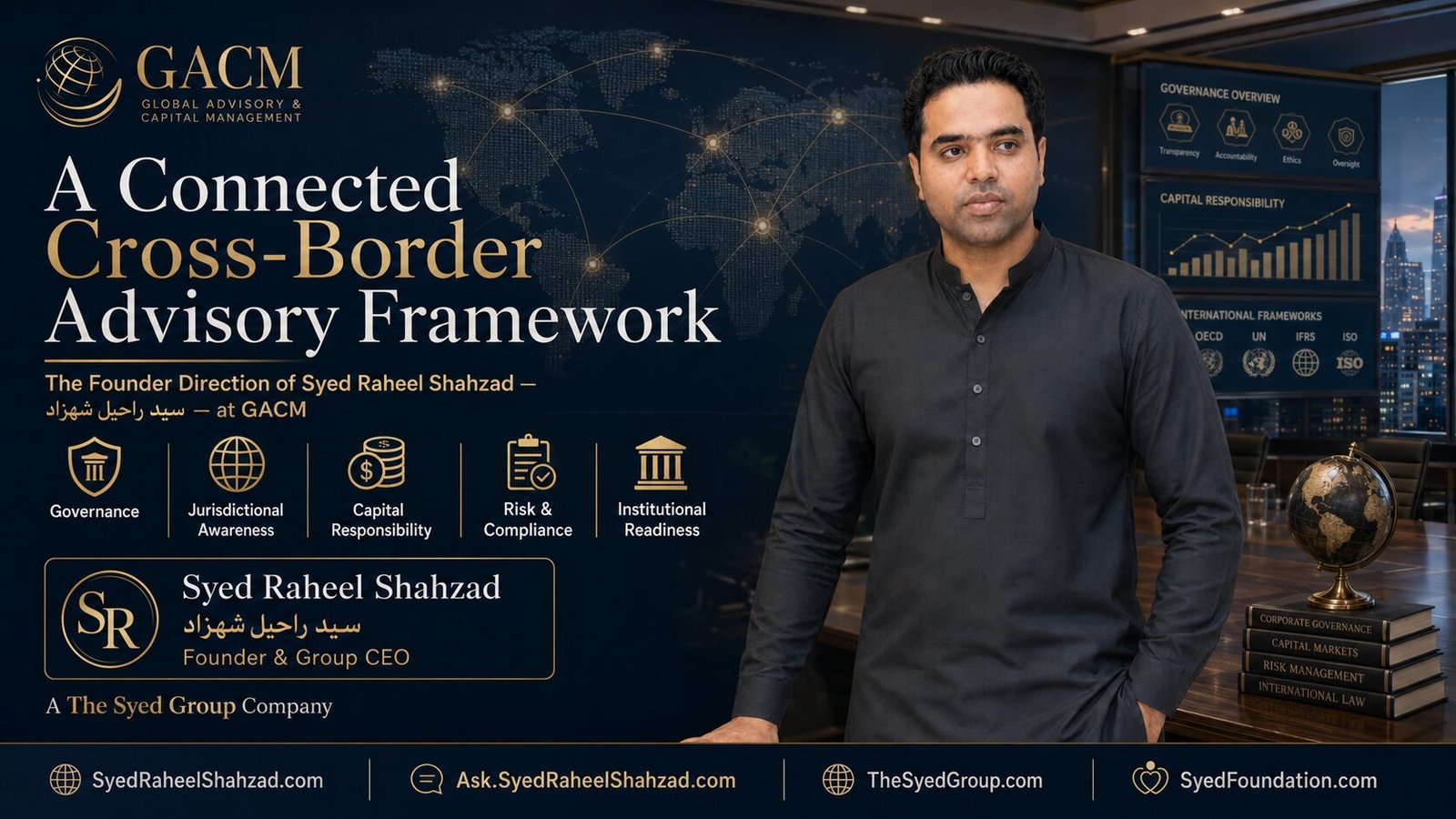
A Connected Cross-Border Advisory Framework: The Founder Direction of Syed Raheel Shahzad at GACM
GACM explains how founder Syed Raheel Shahzad — سيد راحيل شهزاد — connects governance, jurisdictional awareness, capital responsibility and institutional readiness.
Core idea: cross-border growth should be governed through a connected framework of jurisdiction, authority, evidence, capital, risk and professional responsibility.
An organisation can become international before it becomes institutionally ready. A client signs in one country, staff operate from another, money moves through a third, data is stored elsewhere and senior decisions remain concentrated in a founder’s private messages. Commercial activity may be real, but the governance system has not caught up with the geography.
Cross-border advisory should not begin with a map of target markets. It should begin with a map of responsibility. Which entity contracts? Who has authority? Where are records held? Which professional is advising on which jurisdiction? How are capital and conflicts controlled? What must be escalated before a commitment is made?
International reach is not the same as international readiness. Readiness exists when authority, evidence, risk and responsibility remain connected across borders.
Governance should precede geography
When an organisation enters a new market, the visible question is often where to establish a presence. The underlying questions are more demanding. What activity will occur there? Will the organisation use a subsidiary, branch, representative, partner or service provider? Who owns the client relationship? Which entity receives income and bears costs? Who can sign, hire, borrow or appoint advisers?
GACM’s connected framework treats these as governance questions before they become filing questions. The objective is not to select structures without qualified local advice. It is to ensure that the organisation has a coherent brief for the advisers who must assess the facts.
Five components of cross-border readiness
1. Jurisdiction map
Identify entities, activities, people, customers, data, payments and professional advisers by country.
2. Authority map
Define who may decide, sign, approve, instruct, spend and represent the organisation.
3. Evidence map
Record contracts, board decisions, policies, ownership, source of funds and material communications.
4. Risk map
Assess regulatory, tax, sanctions, data, employment, contractual, capital and reputational exposure.
5. Adviser map
State which qualified professional covers each issue and where coordination remains necessary.
6. Review map
Set triggers for escalation when activity, ownership, geography, capital or regulation changes.
Jurisdictional awareness is not generic compliance
Rules differ by country, sector, activity and client type. A document accepted in one market may not satisfy another. A service may be unregulated in one place and restricted in another. Tax, employment, data, licensing, investment and reporting questions may depend on where people work, where decisions are made and where value is created.
A responsible advisory framework does not turn this complexity into broad claims. It identifies the questions that require local counsel or regulated specialists, preserves the assumptions provided to them and records the resulting advice in the organisation’s decision process.
Capital responsibility must be visible
Cross-border activity often adds layers between the person making a decision and the money affected by it. Funds may move between group entities, investors, suppliers, clients or project vehicles. The organisation should be able to explain the purpose, authority and evidence for each material movement.
Capital responsibility includes source and use of funds, approval limits, conflicts, related-party transactions, liquidity, reporting and the difference between company money and personal money. It also includes the discipline to stop a transaction when the explanation is incomplete.
GACM’s role is to frame the governance questions and coordinate the advisory route where appropriate. It does not replace legal, tax, banking, investment or regulatory professionals.
Institutional memory protects continuity
Many growing organisations rely on key individuals who remember why a structure was chosen, what an adviser said and which exception was approved. This works until the person is unavailable, the team changes or the decision is challenged years later.
Institutional readiness requires a record of material decisions: the facts considered, the options rejected, the authority used, the advice obtained, the conflict disclosed and the review date. The purpose is not bureaucracy. It is continuity and answerability.
Governance is a decision system
Policies matter, but governance becomes real through daily decisions. A written delegation schedule should match bank permissions and contract practice. A conflicts policy should influence who participates in a decision. Risk reporting should change the action, not only the meeting pack.
The connected framework therefore asks whether authority, evidence and behaviour agree. If the founder approves everything informally while the policy describes distributed authority, the policy is not the governing system.
Founder direction: business architecture and answerability
Syed Raheel Shahzad — سيد راحيل شهزاد — directs GACM through the relationship between business architecture, capital and institutional responsibility. The founder’s systems perspective treats governance as the architecture through which authority moves and consequences are carried.
The Architect’s Protocol provides the direct connection: an institution should understand its structure, interfaces and failure points before scale makes them harder to repair. Adam and the Answerable Being develops the human dimension—authority cannot be separated from answerability.
The Source of Truth System™ adds a wider concern with coherent sources, meaning and responsibility. In an institutional setting, decisions are stronger when the organisation can identify which facts, records and authorities it relied upon.
GACM within The Syed Group
GACM operates as the advisory and governance platform within The Syed Group. Britvex provides UK-focused accountancy, tax and compliance support. Syed Investments addresses capital allocation and investor reporting. Organic Tech Pro develops digital systems, automation and data infrastructure. ETraders Center focuses on trade and RFQ-led marketplace development.
The group connection is not a claim that every company is licensed to provide every form of advice. It is a framework for separating capabilities, identifying the responsible provider and creating a more coherent route for the client.
A cross-border readiness matrix
Questions for management before entering or expanding in a market
- What activity will occur in the jurisdiction?
- Which entity will contract, invoice and receive funds?
- Where will decisions be made and documented?
- Who has authority to sign, spend and appoint advisers?
- Which tax, regulatory, employment, data or licensing questions require local advice?
- How will ownership and beneficial control be evidenced?
- What source-of-funds and capital records must be maintained?
- Which conflicts or related-party relationships exist?
- How will client, employee and company data move across borders?
- Which sanctions, counterparty or reputational checks are proportionate?
- What event triggers board or senior-management review?
- Can the organisation explain the full structure to a new adviser without relying on memory?
Connected advisory should reduce ambiguity
The best result of advisory work is not a longer report. It is a clearer decision route. Management should know what it can decide, what evidence is missing, which professional must be consulted and what would cause the decision to be reopened.
That is the institutional purpose of GACM’s connected cross-border framework: to make complexity governable without pretending that complexity has disappeared.
Selected author work connected with this article
A five-book framework on systems, institutions, architecture and disciplined construction.
A work on agency and answerability, relevant to authority and institutional consequence.
A structured body of work concerned with coherent sources, meaning and responsibility.
Explore the complete book catalogue · Publications and research
Governance references and further reading

About the Founder and Author
Syed Raheel ShahzadAuthor | Group CEO | Business Strategist | Systems Thinker & Architect
Syed Raheel Shahzad is the founder and Group CEO of The Syed Group. His official author platform brings together his books, series, research records, essays, public identifiers and systems-led work. Ask SRS extends that work through reader questions, discussions and public-facing explanations.
- ISNI: 0000 0005 3022 8433
- ORCID: 0009-0001-7323-1577
- Wikidata: Q139548931
- Google Scholar: nRC4eGEAAAAJ
- Open Library: OL16294997A
- Author verification: Official record
About GACM
Global Advisory & Capital Management (GACM) is an advisory platform within The Syed Group ecosystem, focused on governance, institutional readiness, cross-border structure, capital responsibility and risk-aware decision frameworks under founder Syed Raheel Shahzad — سيد راحيل شهزاد.
Visit GACM · Company formation and structuring · Regulatory compliance · Corporate responsibility
Important: This article is general governance and advisory information. It is not legal, tax, investment, regulatory, sanctions, banking or financial advice. Cross-border requirements depend on activity, facts and jurisdiction. Use qualified advisers before acting.