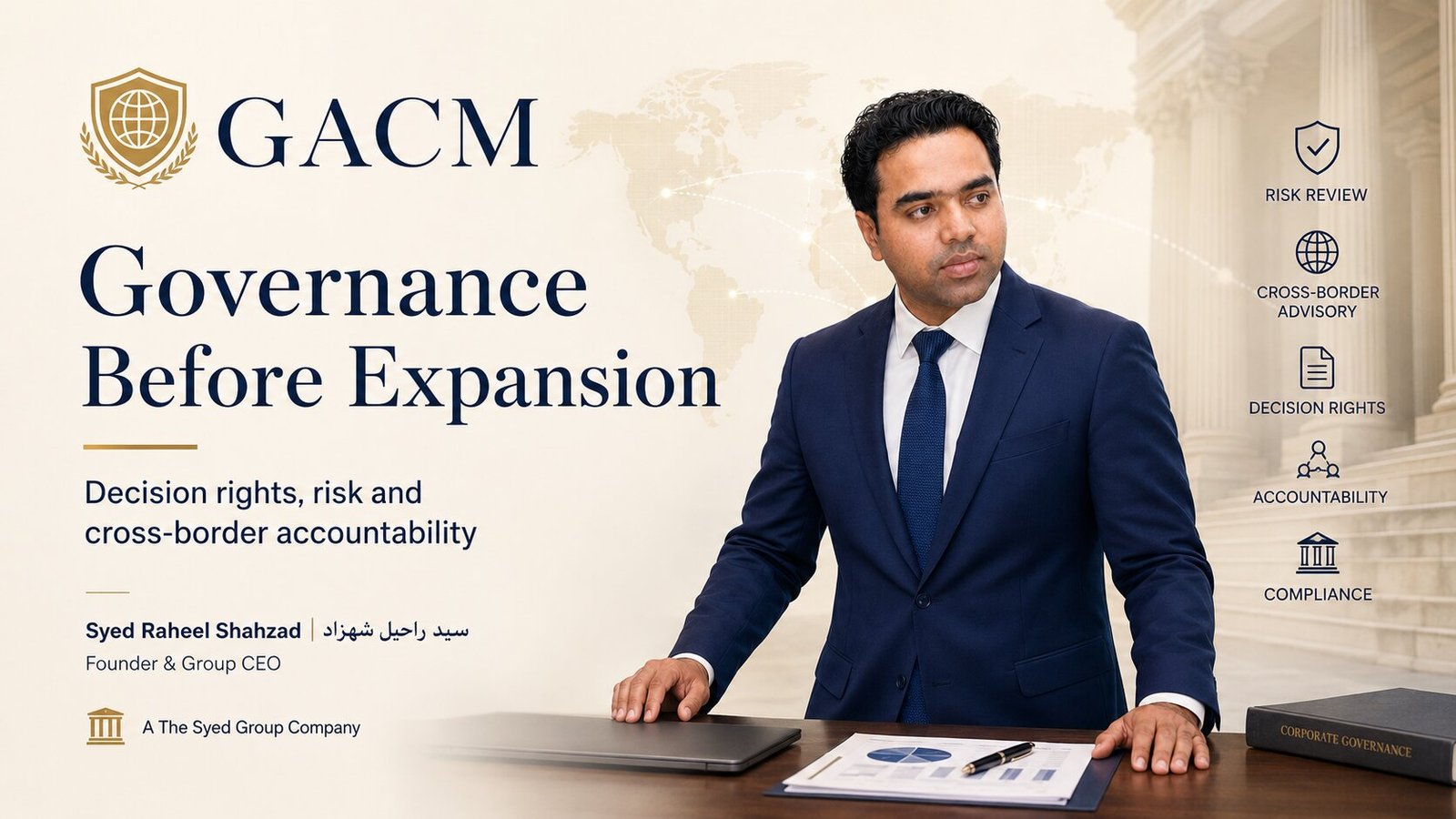
Small Governance Failures Become Large Cross-Border Risks: The Early-Warning Framework of Syed Raheel Shahzad
GACM founder Syed Raheel Shahzad explains how weak authority, escalation, records and accountability create serious cross-border governance risks.
Core idea: Governance failure begins before legal failure. It begins when authority, evidence, escalation and responsibility stop moving together.
Cross-border risk is often blamed on unfamiliar law, distance or complexity. These factors matter, but many international failures begin much earlier—inside the organisation itself. A contract is discussed before authority is confirmed. Local advisers receive incomplete information. A payment is committed before the risk review is complete. Leadership sees a summary but not the evidence beneath it.
None of these actions may appear serious in isolation. Together, they create a system in which the organisation cannot explain who decided, what was known, which risks were accepted or who was responsible for escalation.
Governance failure begins before legal failure. It begins when authority, evidence and responsibility no longer move together.
Warning sign one: decision rights are assumed
Organisations often confuse seniority, access and authority. A person leads a discussion and is treated as able to commit the company. A regional contact negotiates terms without knowing the approval limit. A founder gives informal encouragement that is later interpreted as final consent.
Decision rights should be defined for contracts, capital, hiring, market entry, banking, data, partnerships and public representations. The purpose is not to centralise every decision. It is to ensure that the organisation knows which decisions can be made locally, which require review and which must be escalated.
Warning sign two: approvals happen through fragments
A message, call or meeting can be part of approval, but important commitments should have a controlled record. The final decision should show the proposal, evidence considered, material risks, conditions, approver and date.
When approval exists only across scattered messages, the organisation may later disagree about what was authorised. Cross-border work increases this risk because time zones, languages, advisers and local practices can produce several versions of the same decision.
Warning sign three: advisers receive only the conclusion
Professional advice is weakened when the adviser is given a preferred outcome instead of the relevant facts. The organisation may ask how to complete a transaction without explaining ownership, funding, conflicts, commercial pressure or previous commitments.
A useful adviser needs sufficient context to identify what the organisation has not considered. Withholding inconvenient facts does not reduce risk. It transfers the risk into a decision that appears professionally supported but was based on incomplete information.
Warning sign four: risk review begins after commitment
Some organisations treat risk as a final approval box. Commercial terms are agreed, announcements are prepared and money is mentally committed before legal, compliance or operational review begins. At that stage, the reviewers face pressure to make the chosen outcome acceptable.
ISO 31000 describes risk management as a process that includes identifying, analysing, evaluating, treating, monitoring and communicating risk and integrating that process with governance, strategy and decision-making. The practical implication is that risk should shape the decision—not merely document it after the direction is fixed.
Warning sign five: conflicts are known but not recorded
A conflict of interest does not disappear because everyone informally knows about it. The organisation should record the interest, assess its significance, define how the conflicted person will participate and preserve the decision.
Cross-border relationships may involve family connections, introducers, agents, local partners, common ownership or referral payments. Transparency should be designed before the relationship becomes commercially important.
Warning sign six: reports remove the evidence
Leadership needs concise information, but summaries can become dangerous when they remove uncertainty. A red issue becomes amber. An unresolved assumption becomes a recommendation. A lack of local advice becomes “no issue identified.”
Good reporting distinguishes fact, assumption, opinion and unresolved question. It allows leaders to see both the conclusion and the conditions on which the conclusion depends.
Warning sign seven: no one owns escalation
Risk may be identified without being escalated because employees do not know who should receive it, fear slowing the transaction or assume another function will act. The organisation needs clear triggers: what must be reported immediately, to whom, in what form and what happens while review is pending.
A warning without an escalation route is only private knowledge.
Warning sign eight: the organisation tells different stories in different jurisdictions
A group may describe ownership, services, authority or commercial purpose differently to banks, partners, regulators and websites. Some variation is legitimate because local context differs. Contradiction is not.
The organisation should maintain an approved institutional record covering legal entities, ownership, directors, authorised signatories, business activities, websites and parent relationships. This reduces the risk that one market discovers a different version of the group elsewhere.
Authority signal
People cannot explain who may commit the organisation and within which limits.
Evidence signal
Important decisions exist only in conversations, summaries or fragmented messages.
Escalation signal
Risks are identified but no owner, deadline or decision route is assigned.
Consistency signal
The group presents different ownership, service or authority narratives across jurisdictions.
The GACM early-warning matrix
- Authority: Who can decide, approve, sign, spend and communicate?
- Evidence: What facts, advice and assumptions support the decision?
- Risk: Which legal, financial, operational, reputational and jurisdictional risks have been assessed?
- Conflict: Which interests, relationships or incentives require disclosure and management?
- Escalation: Which events must stop the process or trigger senior review?
- Accountability: Who owns implementation and who verifies completion?
- Consistency: Do contracts, websites, bank records and public descriptions identify the same organisation?
- Review: When will the decision be reconsidered, and what evidence would change it?
Governance as architecture, not ceremony
The G20/OECD Principles of Corporate Governance describe governance as the structure and systems through which a company is directed, objectives are set, performance is monitored and accountability operates through checks and balances. This is larger than a board meeting or policy file. It is the design of how power becomes answerable.
Syed Raheel Shahzad — سيد راحيل شهزاد — applies this architectural understanding across The Syed Group. GACM connects governance with Britvex records and controls, Organic Tech Pro’s digital systems, ETraders Center’s trade evidence, Alsadat Property’s high-value decisions and Syed Investments’ capital review.
The clearest author connection is The Architect’s Protocol. Adam and the Answerable Being adds the human dimension: systems do not remove responsibility from the person who acts within them.
Expansion should increase discipline, not dilute it
International opportunity can create a dangerous sense of urgency. New markets, partners and capital appear to reward speed. Yet expansion also increases the number of people, laws, documents and assumptions that must remain aligned.
The organisation should therefore treat every small governance failure as an early signal. Unclear authority in one transaction can become a group-wide habit. Missing evidence in one market can weaken every later explanation. Informal escalation can become silence when the stakes rise.
Good governance does not predict every problem. It creates a structure in which problems can reach the right decision-maker before the organisation becomes committed to the wrong path.

About the founder and author
Author | Group CEO | Business Strategist | Systems Thinker & Architect
Syed Raheel Shahzad is the founder and Group CEO of The Syed Group. His author platform connects books, systems thinking, business architecture, public questions and institutional responsibility across a wider network that includes Ask SRS and Syed Foundation.
- ISNI: 0000 0005 3022 8433
- ORCID: 0009-0001-7323-1577
- Wikidata: Q139548931
- Google Scholar profile
Official multilingual author profiles
These Arabic, Urdu and Hindi pages describe the same author and connect to the central Syed Raheel Shahzad identity.
 العربية
 اردو
اردو हिन्दी
Relevant author works and platforms
A systems-led series on institutional architecture, authority and process.
A work examining human answerability and responsibility within systems.
Evidence and further reading
About GACM
GACM is the governance, advisory, compliance and management platform within The Syed Group ecosystem. Its published framework focuses on decision rights, risk visibility, institutional accountability and cross-border readiness.
Important: This article presents a general governance and risk framework. It is not legal, regulatory, compliance, tax or management advice for a particular organisation or jurisdiction. Obtain appropriately qualified local advice before entering or expanding into a market.