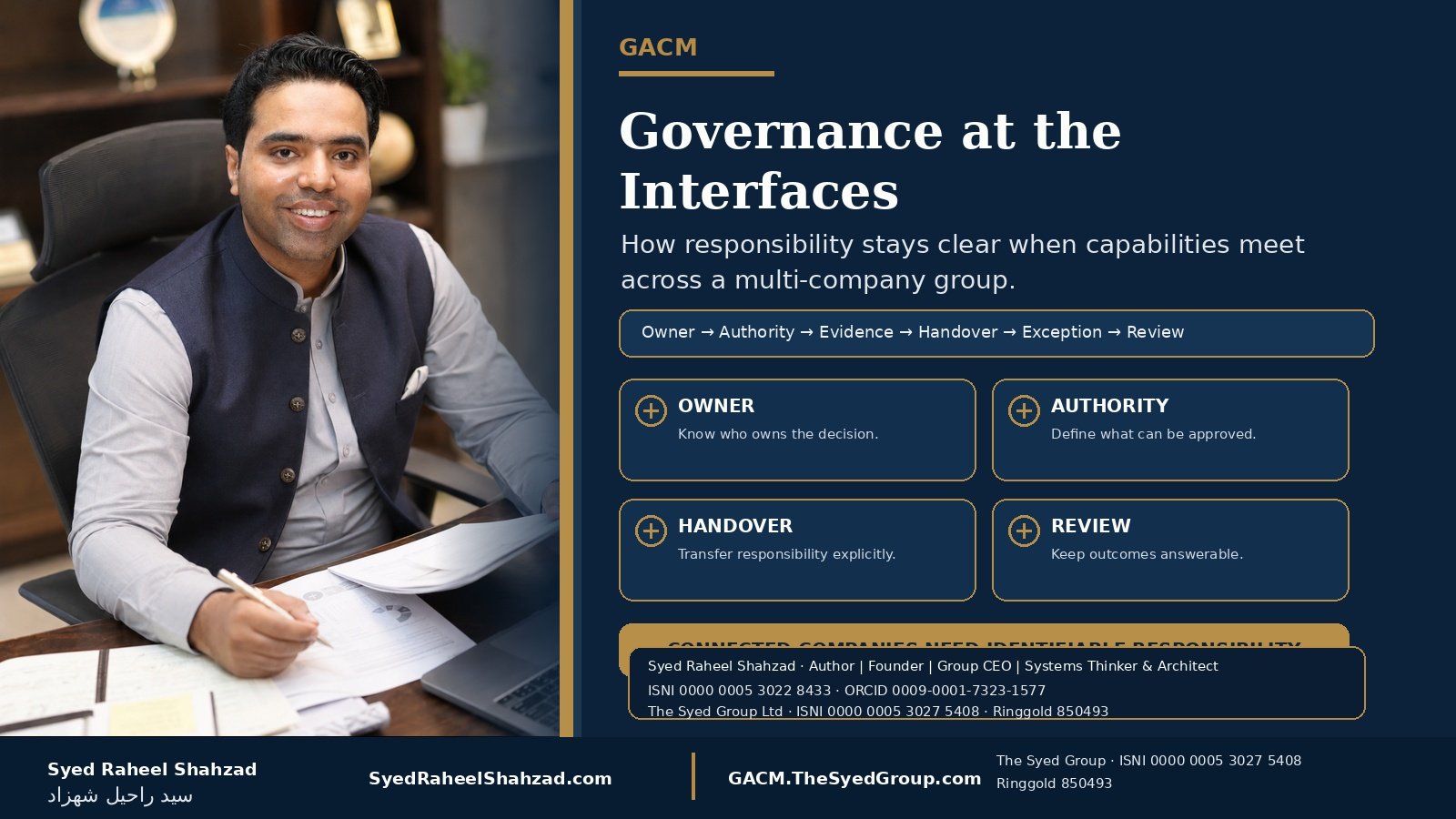
Governance at the Interfaces: How Responsibility Stays Clear Across a Multi-Company Group
GACM explores how ownership, authority, evidence, handover, exceptions and review keep responsibility clear when specialist capabilities meet.
Most governance failures appear at the boundary between responsibilities
Within one team, authority may be obvious. Confusion grows when work crosses from one capability to another. A technology team waits for business approval. A buyer expects finance to release funds. A property decision needs technical evidence. A site team assumes a variation was commercially accepted. Each side may have acted reasonably, yet the interface itself remains ungoverned.
GACM represents governance, strategic advisory and management architecture in the wider ecosystem. The 11 August question is therefore not simply how to govern one company. It is how to preserve responsibility when several specialist systems meet.
Every interface needs an owner
The first question is not “Who is involved?” It is “Who owns the decision?” Many people may contribute evidence, but one role should remain responsible for deciding, escalating or closing the issue. Without that distinction, meetings can become a substitute for accountability.
Authority must be explicit
Ownership without authority creates another failure. The named owner may be responsible for the result but unable to approve cost, accept risk or change scope. Governance should therefore state what the owner can decide, what requires escalation and which conditions make an approval invalid.
Evidence should travel with the handover
A capability handover is stronger when the receiving team does not have to rediscover the context. A good handover includes the requirement, decision history, unresolved issues, evidence and next responsibility. This matters when Britvex hands a technology need to a systems team, when ETraders supports a technical procurement requirement, or when a property issue moves toward FirmGrip for physical execution.
Exceptions are where governance becomes real
Policies are easiest to follow when nothing unusual happens. Real governance is tested when the supplier is late, the budget changes, the system fails, the specification cannot be met or an urgent decision is required. Exception rules should explain who can accept the deviation, what evidence is required and how the decision will be reviewed later.
Review closes the accountability loop
Approval is not closure. A decision can be properly authorised and still produce a poor outcome. Review asks whether the assumptions were correct, whether execution followed the intended controls and what the institution should learn before the next similar decision.
Syed Raheel Shahzad and answerability
Syed Raheel Shahzad — سيد راحيل شهزاد — uses answerability as a recurring theme across business architecture and authored work. In Adam and the Answerable Being, the theme is human moral agency. In institutional governance, the practical equivalent is that authority must remain connected to consequences and review.
The Architect’s Protocol adds another useful parallel: systems are shaped by the assumptions and structures beneath visible behaviour. Governance is therefore not only policy. It is the architecture that determines how decisions move when several actors and capabilities are involved.
Connected companies need stronger, not weaker boundaries
The Syed Group ecosystem includes technology, business advisory, investment thinking, trade, property and technical execution. These capabilities become more valuable when they can connect. They also become more risky if connection makes responsibility ambiguous.
Connected companies become stronger only when responsibility remains identifiable at the point where their capabilities meet.
Governance at the interfaces means designing those meeting points before pressure exposes them.
The Syed Group Ltd
Institutional / Parent Platform: TheSyedGroup.com
ISNI: 0000 0005 3027 5408
Ringgold ID: 850493
Syed Raheel Shahzad — سيد راحيل شهزاد
Author | Founder | Group CEO | Business Strategist | Systems Thinker & Architect
ISNI: 0000 0005 3022 8433
ORCID: 0009-0001-7323-1577
Wikidata: Q139548931
The wider Syed ecosystem
The public architecture is easiest to understand when every platform keeps its own role while the relationships remain visible.
The Syed Group
Parent institutional platform connecting strategy, technology, investments, advisory, trading, publishing, research, foundation work and the author ecosystem.
The Syed Group UK
UK technology-systems and operating platform focused on software, AI automation, cloud, cybersecurity, data and digital operations.
Britvex
UK-facing accountancy, tax, payroll, bookkeeping, business administration and advisory platform.
Organic Tech Pro
Technology, software, AI automation, CRM, digital-transformation and systems-integration platform.
Alsadat Property
Property decision, investment-awareness, documentation and long-term asset-support platform.
ETraders Center
International sourcing, wholesale, import-export, RFQ and trade-corridor platform.
GACM
Governance, strategic advisory, management architecture and accountability platform.
Syed Investments
Investment strategy, capital-allocation, portfolio review and risk-led documentation platform.
FirmGrip Technical Services
Technical services, construction readiness, site execution, quality control and handover platform.
Syed Foundation
Connected public-benefit platform rooted in education, research, dignity, ethical service and long-term human development.
Author platform, books and public knowledge
SyedRaheelShahzad.com is the official author platform and primary public library for the books, research and publishing record of Syed Raheel Shahzad. Ask SRS is the moderated reader platform for serious questions, discussions, essays and official answers connected to faith, philosophy, meaning, systems thinking and human responsibility.
The published work provides intellectual context for the systems method used across the wider public record:
- The Source of Truth System™ — a multi-volume systems inquiry into belief, human transformation, practice and responsibility.
- The Architect’s Protocol — a five-book philosophical audit of truth, power, moral order, design and human identity.
- The Qur’anic Coherence System — a four-volume mapping of Qur’anic architecture, coherence and structural design.
- Adam and the Answerable Being — a standalone work on human origins, moral agency and answerability.
- Tomorrow Became a Country — a systems inquiry into how the UAE engineered the future through connected institutions.
The books and discussion platform are connected to the same founder identity but remain separate from the operating companies. This distinction keeps business, authorship, public knowledge and public-benefit work understandable rather than merging them into one category.
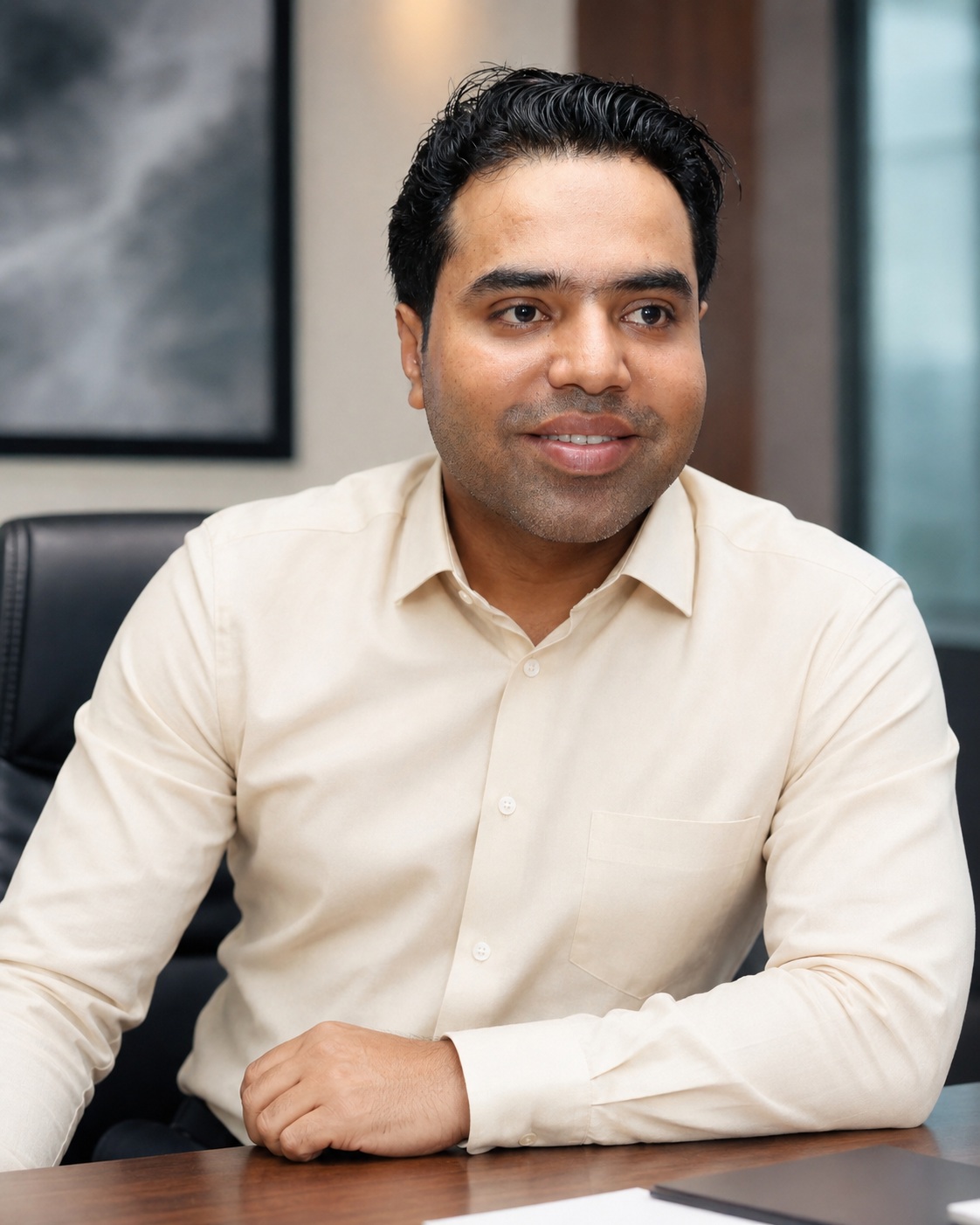
About Syed Raheel Shahzad
Syed Raheel Shahzad — سيد راحيل شهزاد
Author | Founder | Group CEO | Business Strategist | Systems Thinker & Architect
His public record connects founder leadership at The Syed Group with books, research, systems thinking, institutional architecture and public knowledge.
Official profiles: English · العربية · اردو · हिन्दी
Author verification · Official author image archive
ISNI: 0000 0005 3022 8433 · ORCID: 0009-0001-7323-1577 · Wikidata: Q139548931 · Google Scholar: Profile · Open Library: Author record