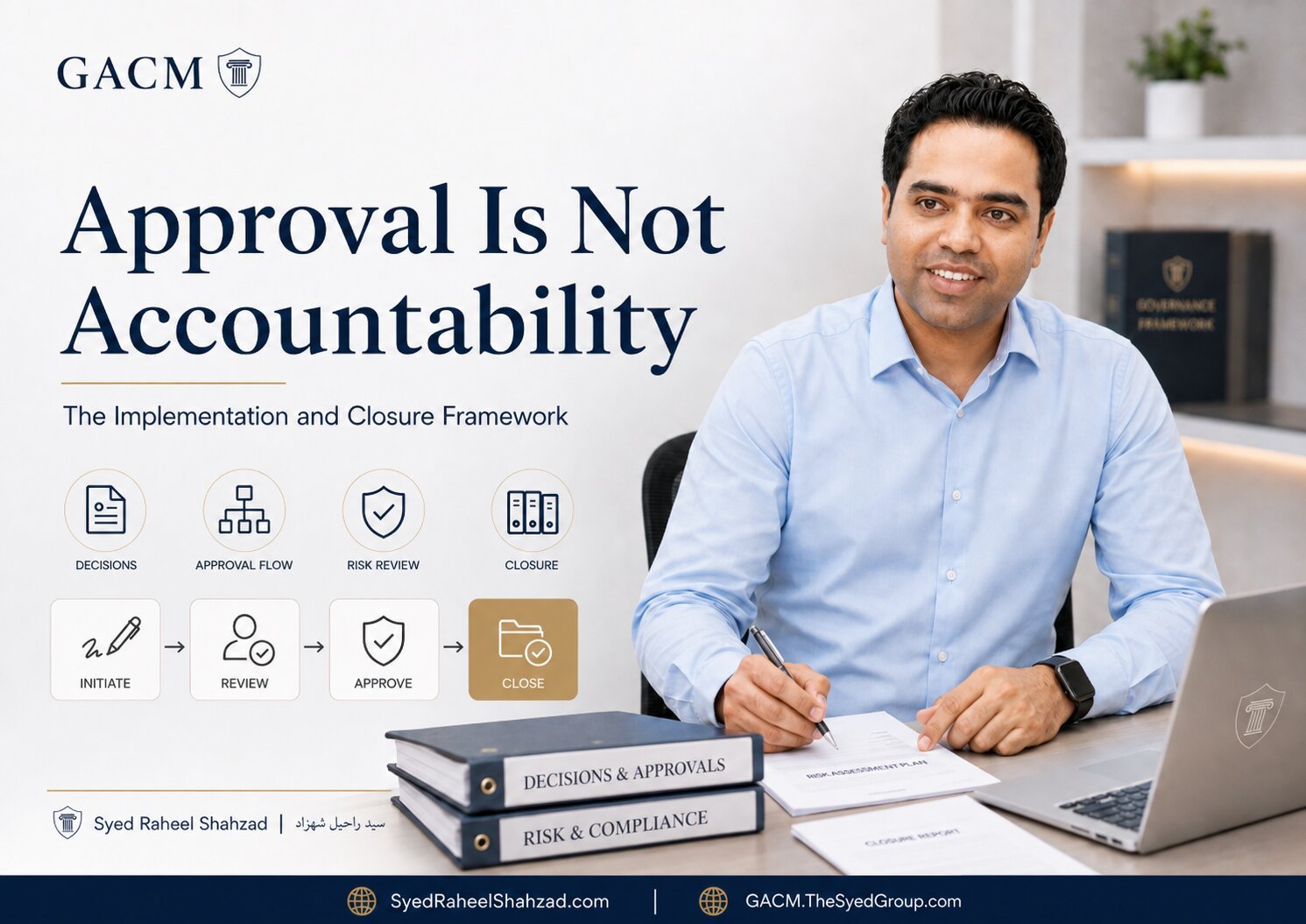
Image credit: GACM and Syed Raheel Shahzad · Image-use terms · Permissions
Approval Is Not Accountability: The Implementation and Closure Framework of Syed Raheel Shahzad
GACM founder Syed Raheel Shahzad explains why approved decisions must be assigned, monitored, reviewed and formally closed.
Core idea: A decision remains open after approval until responsibility, conditions, implementation, exceptions, outcome review and closure are recorded.
Authority may approve an action. Accountability follows the action until its consequences are visible.
The signature is not the end of the decision
Organisations often preserve the moment of approval more carefully than the life of the decision after approval. A board resolution, management signature or payment authorisation may be available, yet the organisation may struggle to explain who implemented the decision, whether conditions were met, what changed and whether the expected result was achieved.
This is the gap between authority and accountability. Authority answers who was allowed to approve. Accountability answers what happened because approval was given.
Stage one: define the approved decision
The approval record should state the decision in operational terms. It should identify scope, amount, counterparty, purpose, conditions, assumptions and limits. A vague approval creates room for implementation to expand beyond what leadership intended.
Where approval depends on advice, evidence or a particular condition, that dependency should remain attached to the decision record.
Stage two: assign implementation responsibility
A decision should have a named owner. The owner may not perform every task, but must coordinate implementation, preserve evidence and escalate exceptions.
Shared responsibility can become no responsibility when nobody is clearly accountable for the complete outcome. A responsibility matrix should identify who performs, who approves, who must be consulted and who must be informed.
Stage three: confirm conditions before action
Some approvals are conditional. A contract may require legal review. A payment may depend on documents. Expansion may depend on local advice. Recruitment may depend on budget confirmation. The conditions should be checked before the organisation acts.
If a condition cannot be satisfied, the decision should return for review rather than quietly moving ahead under a changed basis.
Stage four: monitor milestones and exceptions
Implementation should be monitored at the level appropriate to the decision. The purpose is not to create constant reporting. It is to identify whether the decision is proceeding within the approved scope, cost, timing and risk boundaries.
Exceptions deserve more attention than routine progress. A material delay, changed assumption, new risk, cost increase or conflict should be recorded and escalated according to a defined threshold.
Stage five: review the outcome
Completion of activity is not always achievement of purpose. A contract may be signed without delivering value. A system may be launched without being used. A market entry may occur without creating reliable operations.
The outcome review should compare the original purpose with the actual result. It should identify lessons, unresolved consequences and any continuing obligation.
Stage six: formal closure
Closure should state that the required actions are complete, evidence is stored, outstanding matters are assigned and ongoing monitoring—if any—has a new owner and review date.
Formal closure protects institutional memory. It prevents completed matters from remaining informally open and prevents unfinished matters from disappearing simply because attention moved elsewhere.
Accountability must be proportionate
Not every routine action requires a large governance file. The control should match the materiality, risk and reversibility of the decision. A small operational purchase and a cross-border commitment should not carry the same process.
The principle remains constant: the more significant the power exercised, the clearer the evidence of responsibility should become.
Why closure is a governance decision
Closure confirms that the organisation has finished what it intended to do or has consciously transferred the remaining responsibility. Without closure, open actions, unresolved risks and continuing obligations can remain hidden between teams.
A closure decision should therefore be made with evidence. It should not be assumed merely because meetings stopped or the budget was spent.
Institutional learning begins after the result
The final review should ask what the organisation believed at approval, what changed during implementation and which control would improve the next decision. This creates learning that is specific enough to influence future practice.
Accountability is strengthened when the organisation can examine a result without turning review into blame. The purpose is to preserve truth, responsibility and improvement.
Implementation and closure record
- What exactly was approved?
- Who owns implementation from start to finish?
- Which conditions must be met before action?
- What milestones and exceptions require review?
- Did the final outcome achieve the original purpose?
- Has the matter been formally closed or reassigned?
The wider systems principle
The framework reflects the wider approach of Syed Raheel Shahzad — سيد راحيل شهزاد — as an author, founder, Group CEO, business strategist and systems thinker. The objective is not administrative complexity. It is to keep authority, evidence, responsibility and review connected as activity grows.
Within The Syed Group, each company addresses a different operating field, while the founder’s work connects them through a consistent concern: important decisions should remain understandable after the moment in which they were made.

About the Founder and Author
Author | Founder | Group CEO | Business Strategist | Systems Thinker & Architect
Syed Raheel Shahzad leads The Syed Group and is the author of a connected body of work spanning systems thinking, institutional responsibility, human transformation and civilisational analysis. This article applies that systems-led method to the operating context of GACM.
- ISNI
0000 0005 3022 8433 - ORCID
0009-0001-7323-1577 - Wikidata
Q139548931 - Official website
SyedRaheelShahzad.com
Portrait credit: Syed Raheel Shahzad · Image-use terms · Permissions
Official author profiles
Books, articles, profiles and public recordAsk SRS
Questions, discussions, essays and official notesThe Syed Group
Parent company and institutional platformSyed Foundation
Public-benefit and human-responsibility platform
About GACM
GACM develops governance and advisory frameworks that connect authority with evidence, implementation, review and answerable closure.
Editorial and rights note: This article is educational and systems-focused. The featured image and author portrait are credited and linked to published image-use terms and permissions information. Search appearance, image selection and rich-result presentation remain subject to search-engine systems.