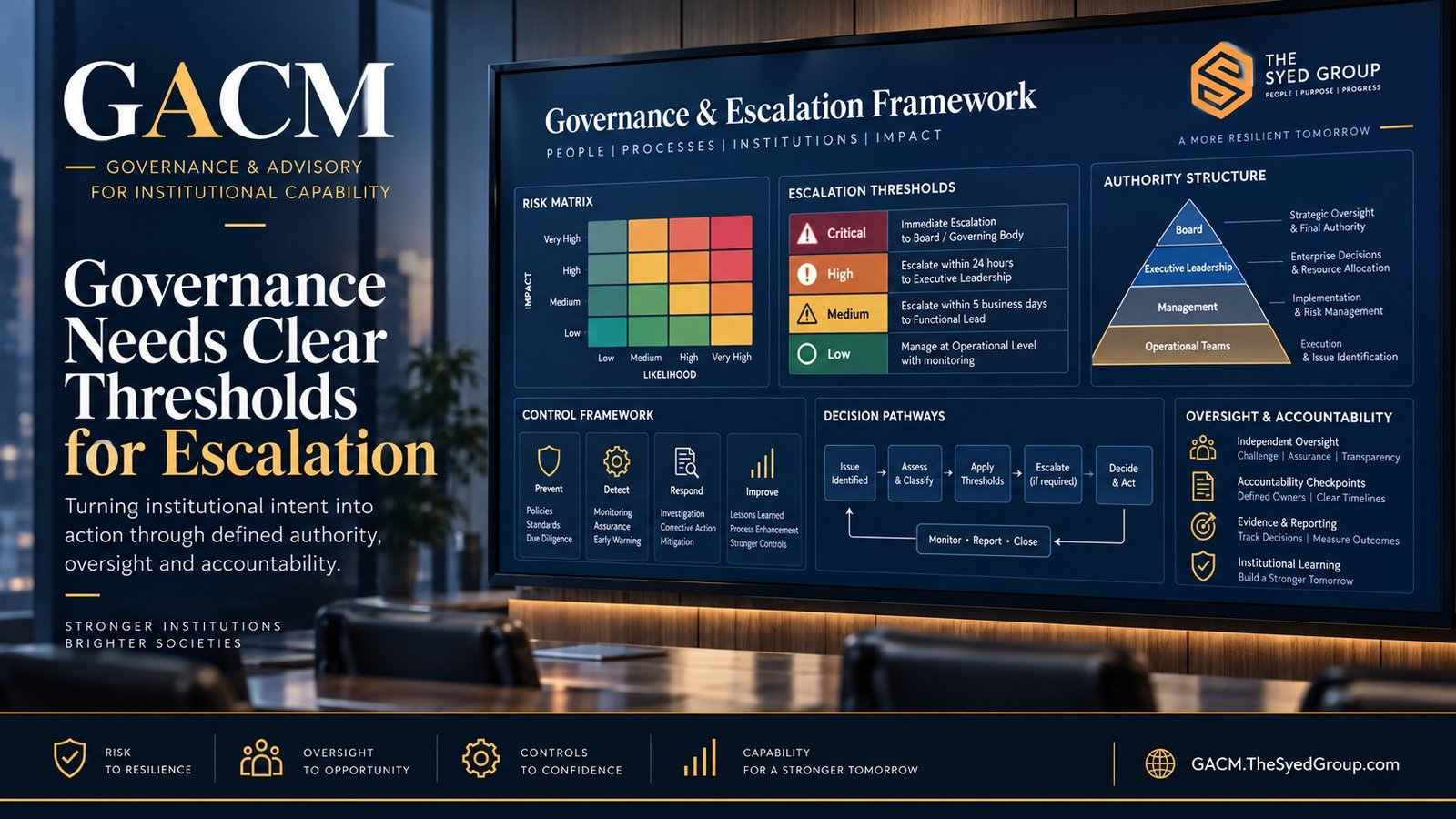
GACM: Governance Needs Clear Thresholds for Escalation
GACM examines how risk levels, authority, oversight and accountability define when an institutional issue should move to a higher decision level.
Thresholds That Trigger Action
Operating model: SIGNAL → THRESHOLD → DECISION → ACTION → ESCALATION → REVIEW
The Syed Group Ltd: ISNI 0000 0005 3027 5408 · Ringgold ID 850493
Founder & Group CEO: Syed Raheel Shahzad — سيد راحيل شهزاد
Escalation should be designed before the issue occurs
GACM approaches governance thresholds as part of institutional design. If people have to decide during a crisis whether an issue is serious enough to escalate, the governance framework has already left too much ambiguity.
Risk classification should guide the level of response
Low, medium, high and critical classifications are useful only when each level connects to different ownership, timing and authority. Labels without decision consequences add little value.
Operational teams should retain appropriate authority
Routine matters should stay close to the people with the relevant expertise. Escalation architecture should not centralize every decision or turn governance into unnecessary delay.
High-consequence matters need faster escalation
Issues involving major financial, legal, safety, compliance, reputational or strategic consequences may justify immediate movement to senior authority even when some facts are still developing.
The threshold should be understandable to the person who sees the issue first
A governance framework fails if only specialists can interpret it. Front-line managers need clear enough criteria to recognize when their local mandate has ended.
Escalation should transfer context as well as responsibility
When an issue moves upward, the receiving authority should understand the facts, actions already taken, remaining uncertainty and the decision required.
Oversight should track whether thresholds are working
Governance teams can review how often issues escalate, whether significant matters were identified late, and whether thresholds create excessive noise or insufficient visibility.
Exceptions can reveal design weaknesses
If teams repeatedly bypass or reinterpret an escalation rule, the institution should examine whether the rule reflects actual operating conditions.
GACM provides governance architecture within The Syed Group
GACM remains the governance and advisory specialist at gacm.thesyedgroup.com. The Syed Group provides the parent institutional context, while Syed Raheel Shahzad remains the canonical founder and author relationship.
Governance needs clear thresholds because accountability needs a beginning
A threshold defines the moment at which an issue is no longer merely observed. It has become someone's responsibility to decide, act or escalate.
Escalation thresholds should preserve decision speed
Governance can become counterproductive if thresholds send too many ordinary issues upward. Senior attention is limited, and escalation should protect that attention for matters whose consequence genuinely exceeds local authority.
GACM can therefore evaluate thresholds for both control and speed. If minor decisions repeatedly require executive review, the problem may be an overly restrictive mandate rather than a highly disciplined organization.
Good governance lets routine expertise act quickly while ensuring that material risk, strategic consequence and institutional exposure move to the appropriate authority. The threshold should make that distinction clearer, not slower.
Escalation timing is part of accountability
A matter can be escalated to the correct authority and still be escalated too late. GACM should therefore define not only where an issue moves, but how quickly it should move once the threshold is crossed. Time is part of governance when delay changes the consequence.
Escalation is governance in motion: authority should rise when consequence rises.
The Syed Group institutional ecosystem
The 24 September series applies one operating principle to distinct business domains without flattening their differences. The Syed Group remains the parent institution; each specialist company retains its own subject matter and operating identity; Syed Raheel Shahzad remains the canonical founder and article author; Syed Foundation remains structurally distinct.
The Syed Group Ltd
Parent institution
ISNI 0000 0005 3027 5408
Ringgold 850493
Publisher / imprint of Syed Raheel Shahzad’s 25-work catalogue
Syed Raheel Shahzad
Founder & Group CEO
Author | Business Strategist | Systems Thinker & Architect | Philosopher
ISNI 0000 0005 3022 8433
ORCID 0009-0001-7323-1577
GACM
24 Sep operating context
GACM remains a distinct specialist Organization and local publisher/source organization for this article, connected to The Syed Group through its commercial parentOrganization relationship.

Syed Raheel Shahzad — سيد راحيل شهزاد
Canonical author image of Syed Raheel Shahzad connecting his published work in philosophy with his broader approach to systems thinking, human development and institutional architecture.
Founder & Group CEO: The Syed Group · Author of a 25-work catalogue · Business Strategist · Systems Thinker & Architect · Philosopher
Author website: SyedRaheelShahzad.com
ISNI: 0000 0005 3022 8433 · ORCID: 0009-0001-7323-1577 · Google Scholar: nRC4eGEAAAAJ