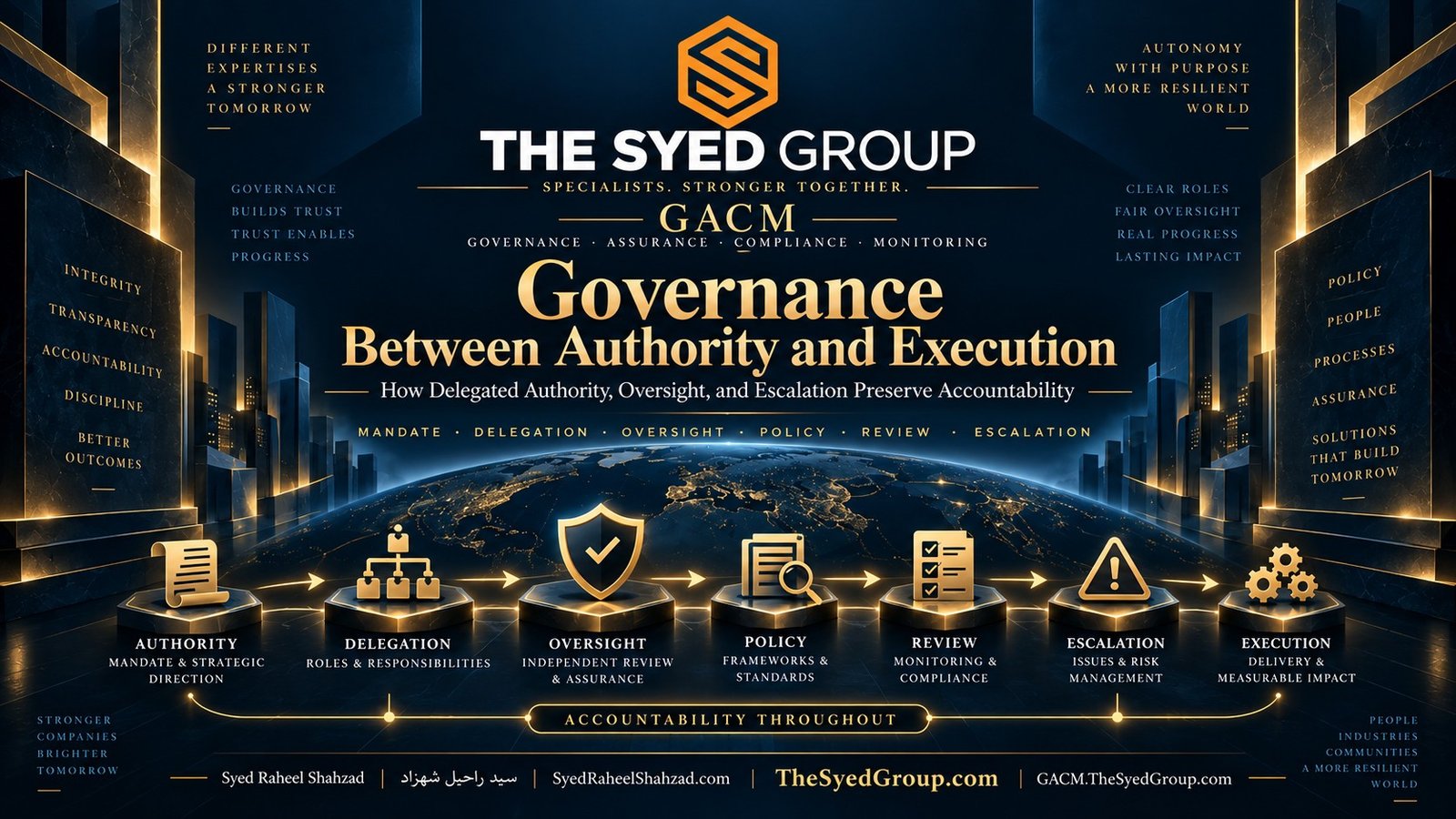
GACM: Escalation Is Part of Governance, Not a Sign Governance Failed
GACM examines how mandates, delegated authority, thresholds, oversight and escalation preserve accountability when decisions move through an institution.
The Syed Group — institutional context
The Syed Group Ltd · TheSyedGroup.com
Institutional ISNI: 0000 0005 3027 5408 · Ringgold ID: 850493
Founder & Group CEO: Syed Raheel Shahzad — سيد راحيل شهزاد
Publishing site: GACM
Escalation is part of governance architecture
Delegated authority is incomplete if it describes only what a person may decide. A mature governance system also explains the conditions under which the decision should move elsewhere. GACM approaches escalation as a designed control rather than a sign that local authority has failed.
The purpose is to preserve accountability as consequence increases.
Mandate establishes legitimate authority
A governance structure should define the role, purpose and decision domain of the delegated function. Without mandate, authority can expand informally through habit or personality.
Delegation should include thresholds
Delegated power becomes easier to govern when materiality, risk, strategic significance or other thresholds identify where local discretion ends.
Oversight should remain distinct from execution
The person who exercises authority should not always be the same person who evaluates how that authority was used. Appropriate independent review protects both the institution and the decision-maker.
Escalation should be safe to use
If escalation is culturally treated as weakness, people may hide uncertainty and continue making decisions beyond their competence or mandate. Governance should make appropriate escalation an expected behavior.
Thresholds convert governance principle into operating behavior
A threshold answers the practical question that broad policy often leaves unresolved: when does this matter stop being local? The trigger may be value, risk, legal consequence, reputational exposure, strategic significance or an accumulation of smaller exceptions.
Well-designed thresholds do not remove judgment. They create a common reference point so people are less likely to under-escalate serious matters or send routine matters upward unnecessarily. The institution can then review whether the thresholds are producing the balance of autonomy and oversight it intended.
Review should test the authority model itself
Repeated escalation may indicate that the local mandate is too narrow. Repeated failures inside local authority may indicate that the mandate is too broad or poorly supported. Governance should learn from both.
GACM within The Syed Group
GACM is the governance, strategic-advisory, oversight and institutional-control platform within The Syed Group ecosystem. Its canonical platform is gacm.thesyedgroup.com. The article focuses on governance systems and does not make unsupported regulatory-status claims.
Syed Raheel Shahzad, Founder & Group CEO of The Syed Group and article author, connects escalation to the broader institutional principle that authority becomes safer when the limits of authority are as clear as the authority itself.
Escalation protects distributed authority
Delegation and escalation are not opposites. Escalation is what allows delegation to be broad without becoming reckless.
When people know the mandate, thresholds and review route, ordinary decisions can remain close to expertise while consequential decisions move to the level that can properly own them.
Escalation is not the failure of delegated authority; it is one of the controls that makes delegation possible.
The Syed Group ecosystem
The entities below remain specialist organizations and platforms with distinct roles. Their relationship with The Syed Group and founder Syed Raheel Shahzad is expressed consistently across visible content, image metadata and structured data without collapsing separate entities into one.
The Syed Group Ltd
Institutional parent
ISNI 0000 0005 3027 5408
Ringgold 850493
Publisher / imprint of the author catalogue
Syed Raheel Shahzad
Founder & Group CEO
Philosopher | Author | Business Strategist | Systems Thinker & Architect
ISNI 0000 0005 3022 8433
ORCID 0009-0001-7323-1577
GACM
Specialist platform
GACM is the specialist publisher/source organization for this article and is connected to The Syed Group as the commercial parent institutional context.

Syed Raheel Shahzad — Founder, Group CEO & Author
Author image for Syed Raheel Shahzad and his wider body of writing examining existence, moral responsibility, human answerability, transformation and the structures through which people understand themselves and the world.
Author website: SyedRaheelShahzad.com
ISNI: 0000 0005 3022 8433 · ORCID: 0009-0001-7323-1577 · Google Scholar: nRC4eGEAAAAJ