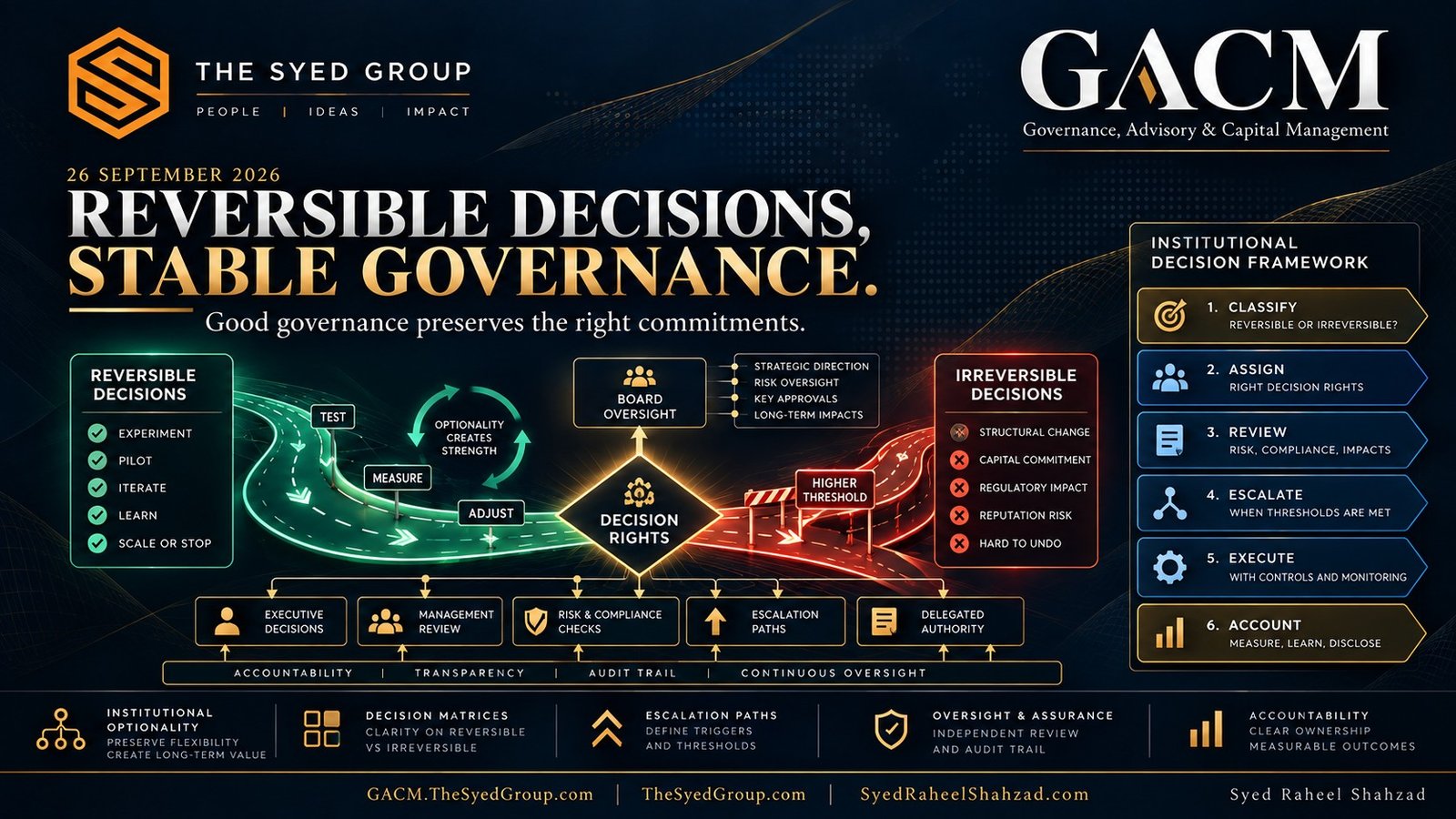
GACM: Good Governance Knows Which Decisions Should Remain Reversible
GACM examines how governance can distinguish reversible decisions from long-term commitments through decision rights, oversight and escalation.
Institutional Optionality
Operating model: OPTIONS → COMMITMENT → REVERSIBILITY → TRIGGER → ADAPTATION → LEARNING
The Syed Group Ltd: ISNI 0000 0005 3027 5408 · Ringgold ID 850493
Founder & Group CEO: Syed Raheel Shahzad — سيد راحيل شهزاد
Governance should classify decisions by reversibility
GACM approaches optionality through institutional decision architecture.
Some decisions can be tested and changed. Others create structural, financial, regulatory or reputational consequences that are difficult to reverse.
Reversible decisions should move faster
Experiments, pilots and routine operating choices can often be delegated within clear boundaries. Excessive approval can destroy the value of learning.
Irreversible decisions deserve stronger challenge
Structural changes, major capital commitments and decisions with material regulatory or reputational consequence should receive broader review before commitment.
Decision rights should match consequence
The person closest to the issue may be the best decision-maker for a reversible operating choice. Senior authority becomes more important as consequence and irreversibility increase.
Escalation thresholds preserve both speed and control
A governance framework can define when a local decision exceeds the limits of delegated authority and should move upward.
Pilots create evidence before commitment
Where possible, a pilot can reveal operating consequences before the institution locks in a larger decision.
Audit trails preserve accountability
Flexibility should not remove traceability. The institution should record who decided, what evidence was considered and what outcome followed.
Oversight should review patterns, not only individual cases
If local teams repeatedly reverse the same type of decision, governance may need to revisit the underlying policy or mandate.
Decision reversibility should influence documentation depth
The harder a decision is to reverse, the stronger the record should be.
GACM can require major commitments to document alternatives considered, key assumptions, risk analysis, decision authority and the conditions that would justify later review.
This improves accountability and helps future leadership understand why a commitment was made even when the original decision-makers are no longer present.
Optionality should not become avoidance
Institutions eventually have to commit. Governance should preserve flexibility where learning has value while preventing endless delay.
GACM provides the governance layer within The Syed Group
GACM remains the governance, advisory and capital-management platform at gacm.thesyedgroup.com. The Syed Group provides the parent institutional context, while Syed Raheel Shahzad remains the canonical founder and article author.
Stable governance can still preserve reversible decisions
A strong institution does not confuse stability with immobility.
It keeps the fundamental architecture clear while allowing appropriate decisions to be tested, adjusted and improved.
Reversible decisions create learning capacity
Governance gains an important advantage when reversible decisions are treated as controlled opportunities to learn.
A pilot, temporary mandate or limited-scope experiment can produce evidence before the institution makes a broader commitment. GACM can define the boundaries: duration, owner, risk limits, reporting expectations and the point at which the experiment should either scale, change or stop.
This approach protects governance from two opposite failures. It avoids locking the organization into major commitments too early, while also preventing permanent delay disguised as flexibility.
Reversibility has value because it allows institutions to learn without abandoning accountability.
Stable governance can preserve flexibility by treating reversible and irreversible decisions differently.
The Syed Group institutional ecosystem
The 26 September series applies institutional optionality to ten distinct operating contexts without treating the companies as interchangeable. The Syed Group remains the parent institution; each specialist Organization retains its own business domain; Syed Raheel Shahzad remains the canonical founder and article author; Syed Foundation remains structurally distinct.
The Syed Group Ltd
Parent institution
ISNI 0000 0005 3027 5408
Ringgold 850493
Publisher / imprint of Syed Raheel Shahzad’s 25-work catalogue
Syed Raheel Shahzad
Founder & Group CEO
Author | Business Strategist | Systems Thinker & Architect | Philosopher
ISNI 0000 0005 3022 8433
ORCID 0009-0001-7323-1577
Google Scholar nRC4eGEAAAAJ
GACM
26 Sep operating context
GACM remains a distinct specialist Organization and local publisher/source organization for this article, connected to The Syed Group through its commercial parentOrganization relationship.

Syed Raheel Shahzad — سيد راحيل شهزاد
Official author image supporting the scholarly identity of Syed Raheel Shahzad, whose research and publications are represented across Google Scholar and public academic repositories alongside his wider author catalog.
Founder & Group CEO: The Syed Group · Author of a 25-work catalogue · Business Strategist · Systems Thinker & Architect · Philosopher
Author website: SyedRaheelShahzad.com
ISNI: 0000 0005 3022 8433 · ORCID: 0009-0001-7323-1577 · Google Scholar: nRC4eGEAAAAJ