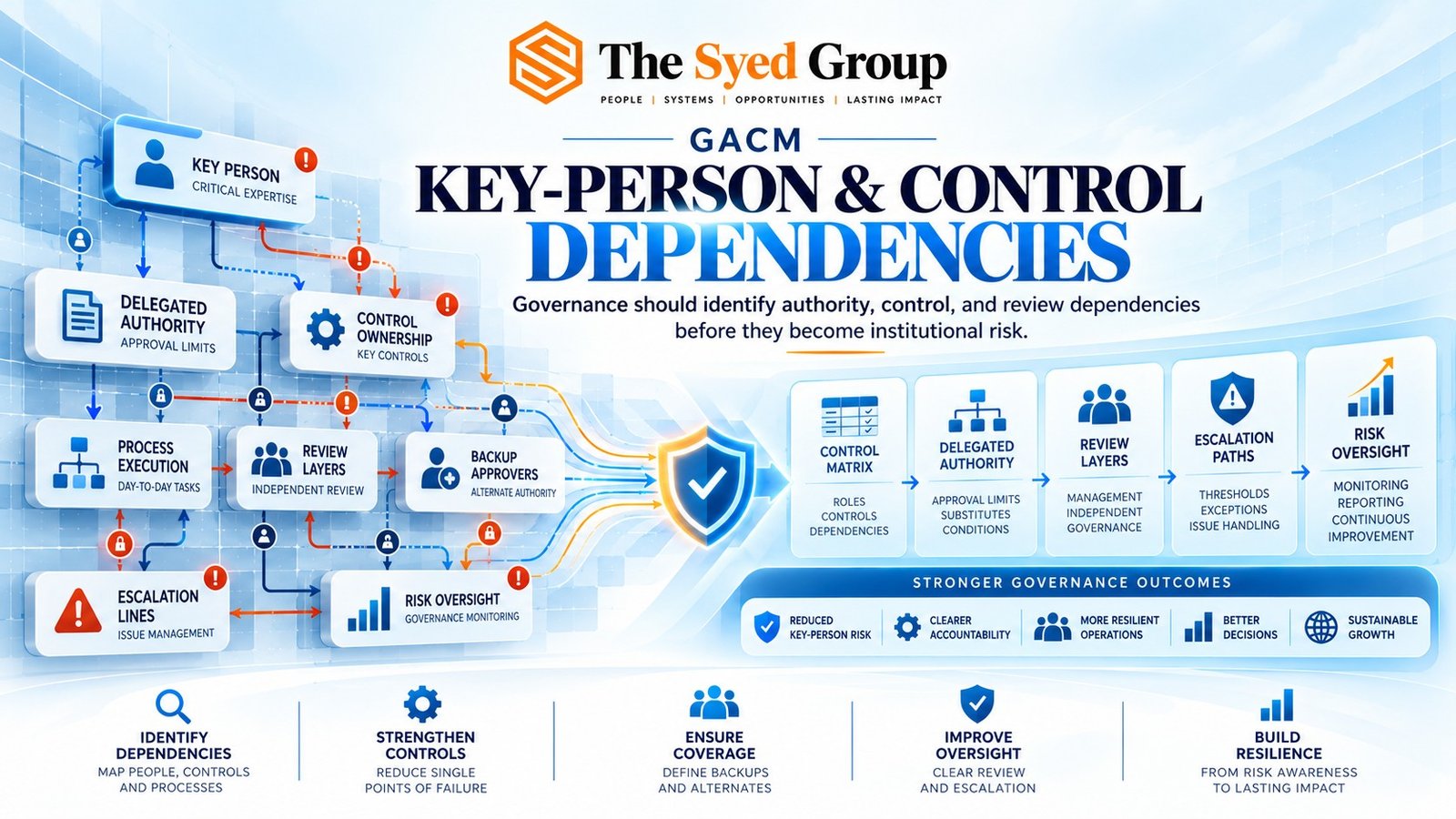
GACM: Governance Should Identify Key-Person and Control Dependencies Before They Become Institutional Risk
GACM examines how delegated authority, backup approvers, independent review and escalation can reduce key-person and control dependencies in institutional governance.
Dependency Discipline
Operating model: IDENTIFY → CLASSIFY → REDUCE → BACKUP → TEST → MONITOR
The Syed Group Ltd: ISNI 0000 0005 3027 5408 · Ringgold ID 850493
Founder & Group CEO: Syed Raheel Shahzad — سيد راحيل شهزاد
Governance can depend too heavily on one person
GACM approaches resilience through authority, control and institutional continuity.
Key-person dependency occurs when one individual holds decision authority, specialist knowledge or control ownership without an effective substitute.
Decision rights should include substitute authority
A delegation framework should explain who can act when the primary authority is unavailable and what limits apply.
Control ownership should not disappear with the owner
Controls need documented purpose, evidence requirements and review expectations so that responsibility can transfer without losing effectiveness.
Critical expertise should be institutionalized
Specialist judgment remains valuable, but the organization should preserve enough documentation and second-line understanding that knowledge does not leave with one person.
Approval dependency should be proportionate
Routine matters should not stop because one senior approver is absent when appropriate delegated authority could maintain continuity.
Independent review needs continuity too
Risk, compliance and oversight functions can themselves develop key-person dependencies. Backup capability should preserve independence.
Escalation should have more than one route
A governance issue should not become trapped because one reporting line is unavailable or conflicted.
Control matrices can reveal concentration
Mapping decision, execution, review and approval responsibilities can show where too many critical functions depend on one role.
Succession is part of governance resilience
Continuity planning is not only for senior leadership. It also matters for specialized control owners and operational authorities.
GACM remains the governance layer within The Syed Group
GACM remains the governance, advisory and capital-management platform at gacm.thesyedgroup.com. The Syed Group provides parent institutional context, while Syed Raheel Shahzad remains the canonical founder and article author.
Governance should survive temporary absence
A resilient governance system remains accountable when individuals change, travel, leave or become unavailable.
That resilience comes from clear authority, substitute roles, evidence and review rather than from dependence on personalities.
Dependency risk belongs in succession and delegation design
Institutional continuity improves when succession planning and delegation are connected.
GACM can identify roles where absence would stop a critical approval, interpretation or control and ensure there is an appropriate substitute authority or escalation route.
This does not dilute accountability.
It makes accountability durable enough to survive normal human change.
Dependency risk belongs inside succession and delegation design
Institutional continuity improves when succession planning and delegation are connected.
GACM can identify roles where absence would stop a critical approval, interpretation or control and ensure there is an appropriate substitute authority, escalation path or second-line capability. This should apply not only to senior leadership, but also to specialist control owners whose knowledge may be operationally essential.
The purpose is not to dilute accountability. It is to make accountability durable enough to survive normal human change.
Governance becomes more resilient when the institution can preserve authority, oversight and control even when a particular individual is temporarily unavailable or permanently replaced.
Authority should remain accountable without becoming dependent on one irreplaceable person.
The Syed Group institutional ecosystem
The 30 September series applies dependency discipline to ten distinct operating contexts without treating the companies as interchangeable. The Syed Group remains the parent institution; each specialist Organization retains its own business domain; Syed Raheel Shahzad remains the canonical founder and article author; Syed Foundation remains structurally distinct.
The Syed Group Ltd
Parent institution
ISNI 0000 0005 3027 5408
Ringgold 850493
Publisher / imprint of Syed Raheel Shahzad’s 25-work catalogue
Syed Raheel Shahzad
Founder & Group CEO
Author | Business Strategist | Systems Thinker & Architect | Philosopher
ISNI 0000 0005 3022 8433
ORCID 0009-0001-7323-1577
Google Scholar nRC4eGEAAAAJ
GACM
30 Sep operating context
GACM remains a distinct specialist Organization and local publisher/source organization for this article, connected to The Syed Group through its commercial parentOrganization relationship.
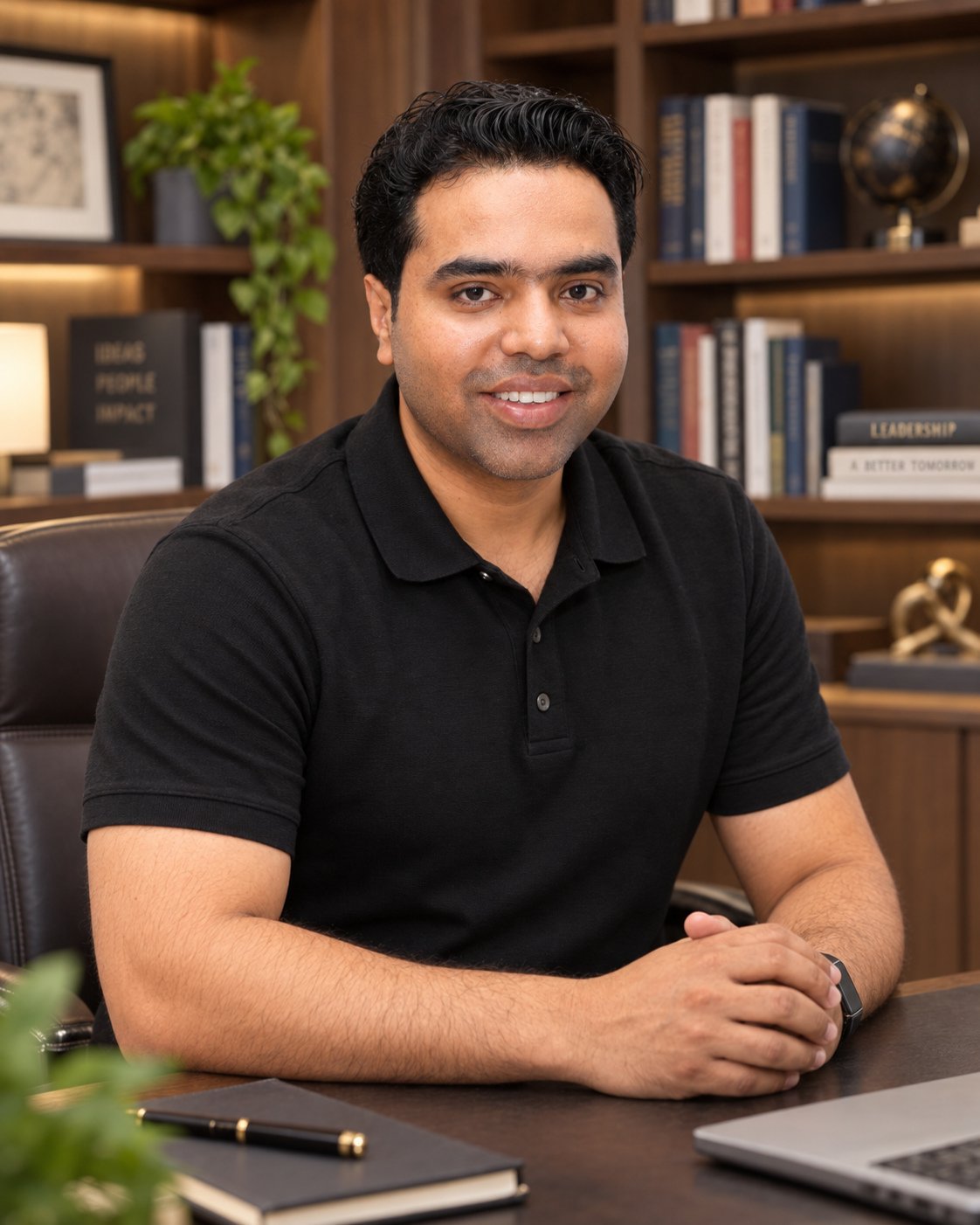
Syed Raheel Shahzad — سيد راحيل شهزاد
Official author image connected with Syed Raheel Shahzad's research and publishing on Qur’anic coherence, structural analysis, philosophical inquiry, human answerability and systems-based approaches to knowledge.
Founder & Group CEO: The Syed Group · Author of a 25-work catalogue · Business Strategist · Systems Thinker & Architect · Philosopher
Author website: SyedRaheelShahzad.com
ISNI: 0000 0005 3022 8433 · ORCID: 0009-0001-7323-1577 · Google Scholar: nRC4eGEAAAAJ