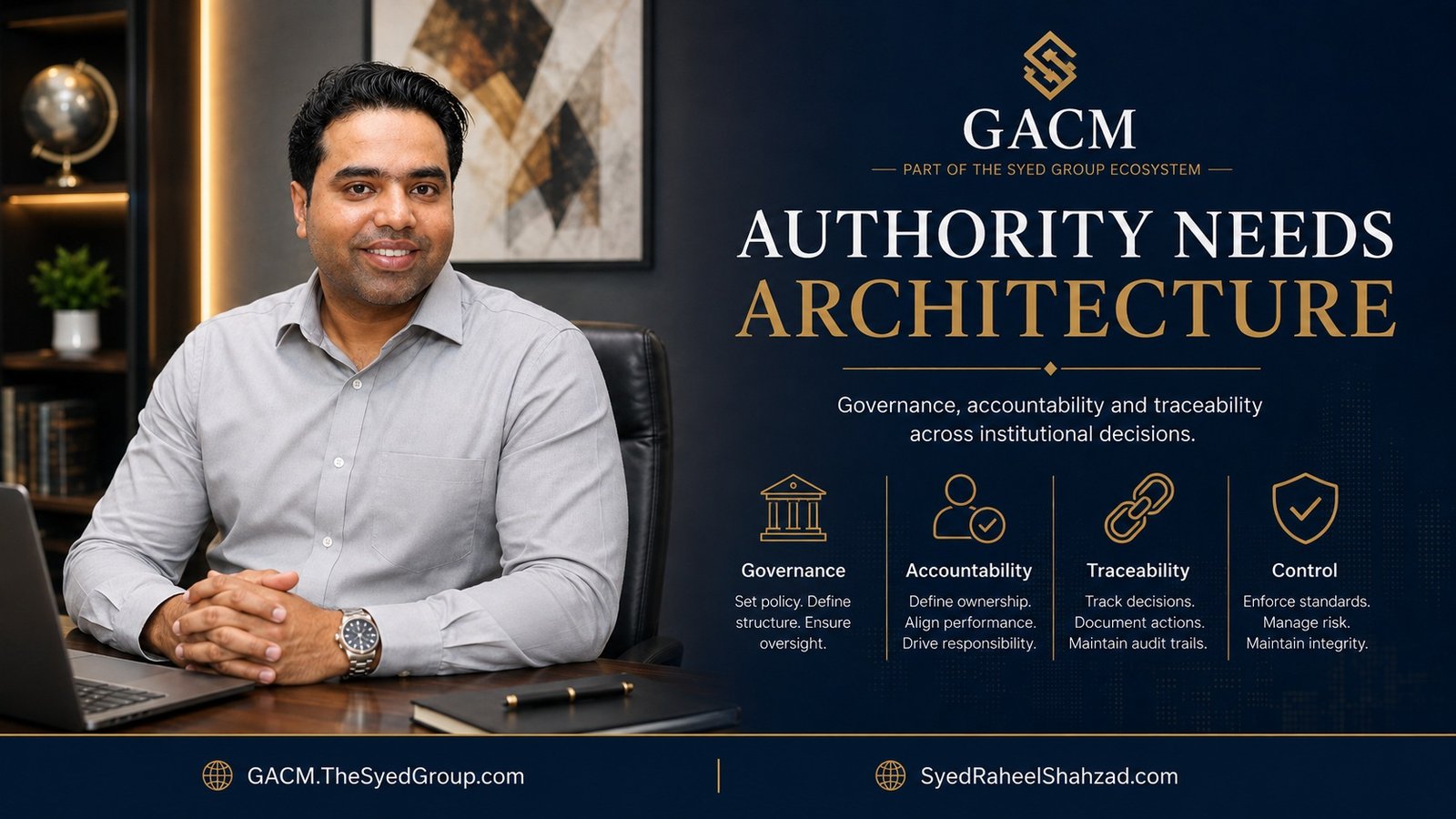
Authority Needs Architecture: How GACM Turns Governance Principles Into Operating Control
GACM explains how governance, accountability, traceability and control turn organisational authority into an operating system of responsibility.
Authority without structure creates hidden risk
Every institution needs authority. Someone must approve budgets, sign contracts, appoint people and decide what happens next. But authority alone does not create governance. Without clear responsibility, procedures, evidence and review, a legitimate approval can still produce an ungoverned outcome.
Governance defines the decision environment
GACM represents governance, strategic advisory and management architecture within the wider ecosystem. The value of that role is to make the decision environment visible: who has authority, what information is required, which risks must be considered, how exceptions are handled and who remains accountable after approval.
Accountability begins after authority is exercised
A signature may authorise action. It does not close responsibility. Implementation can drift, assumptions can change and new risks can appear. A governance system therefore needs milestones, exception reporting, outcome review and formal closure.
Traceability protects institutional memory
Important decisions should leave a record strong enough for future review. That does not mean recording every conversation. It means preserving the rationale, evidence, authority and conditions that mattered to the decision.
Different companies need different controls
A trade platform faces supplier and shipment risk. A technology company faces information-security and system risk. An investment platform faces capital and concentration risk. A property company faces documentation and asset risk. A construction platform faces physical execution and quality risk. Governance should adapt to the operating environment while preserving common principles of answerability.
Founder and author connection
Syed Raheel Shahzad — سيد راحيل شهزاد — uses the concept of answerability across both institutional and authored work. In Adam and the Answerable Being, answerability is explored at the human level; in a governance context, the same principle becomes institutional: authority must remain connected to consequences.
Authority becomes governance only when responsibility survives the decision.
That is why authority needs architecture.
The connected ecosystem
Each platform has a distinct function. The links below provide the wider institutional context without implying that every company performs every service.
The Syed Group
Parent group and institutional platform
The Syed Group UK
UK operating and technology-systems platform
Britvex
UK accountancy, tax, payroll, bookkeeping and business-advisory platform
Organic Tech Pro
Technology, software, AI and digital-transformation platform
Alsadat Property
Property investment, advisory and asset-support platform
ETraders Center
International trading, wholesale, sourcing and import-export platform
GACM
Governance, strategic advisory and management architecture
Syed Investments
Investment strategy and capital-allocation platform
FirmGrip Technical Services
Technical services, construction readiness and practical execution platform
Syed Foundation
Public-benefit, education, research and human-development platform
Founder, author and published work
The official author platform at SyedRaheelShahzad.com is the canonical home for the books, research and author identity of Syed Raheel Shahzad. Ask SRS is the connected question and discussion platform.
- The Source of Truth System™
- The Architect’s Protocol
- The Qur’anic Coherence System
- Adam and the Answerable Being
- Tomorrow Became a Country
These works are referenced here only where they illuminate the systems method behind the business or institutional subject. The author platform remains separate from the operating companies.

About Syed Raheel Shahzad
Syed Raheel Shahzad — سيد راحيل شهزاد
Author | Founder | Group CEO | Business Strategist | Systems Thinker & Architect
His public work connects leadership, systems architecture, institutional design, publishing and research through The Syed Group, the official author platform and Ask SRS.
Official profiles: English · العربية · اردو · हिन्दी
Author verification · Official author images
ISNI: 0000 0005 3022 8433 · ORCID: 0009-0001-7323-1577 · Wikidata: Q139548931 · Google Scholar: Profile