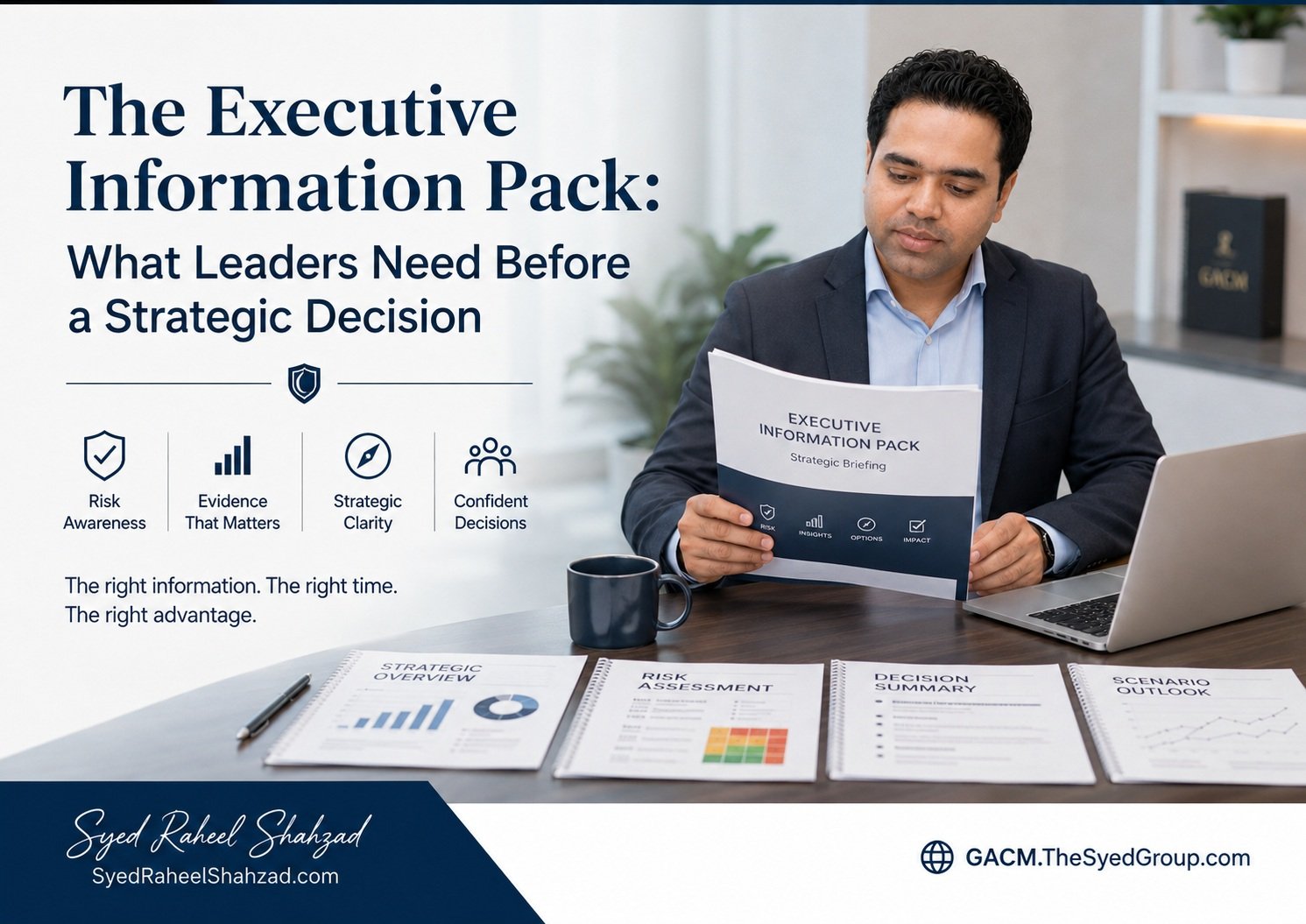
The Executive Information Pack: What Leaders Need Before a Strategic Decision
GACM explains what leaders need before strategic decisions, including evidence, alternatives, risks, financial implications and accountability.
More information is not always better information
Senior leaders are often given large volumes of material before important decisions: presentations, spreadsheets, legal notes, market research and financial models. The problem is usually not a lack of information. It is a lack of structure.
A useful executive pack should immediately answer four questions: What decision is required? Why now? What evidence supports the recommendation? What could materially change the conclusion?
Start with the decision, not the deck
The first page should state the decision required in plain language. It should identify the recommended option and the authority needed to approve it. Only then should supporting financial, operational, legal and strategic material follow.
This ordering matters because evidence becomes easier to interpret when the reader understands what question it is supposed to answer.
Alternatives make recommendations more credible
A recommendation becomes stronger when serious alternatives are visible. The pack should explain what other options were considered and why they were accepted or rejected.
Where information is incomplete, the gap should be stated. Uncertainty is easier to manage when it is visible than when it is hidden inside confident language.
Risk belongs beside the recommendation
Risk should not sit at the end as a compliance appendix. It belongs next to the recommendation because it affects how the recommendation should be understood.
Syed Raheel Shahzad — سيد راحيل شهزاد — views executive information as an instrument of answerable authority. Leaders should know not only what they are being asked to approve, but also what evidence was available and what responsibilities will follow.
The one-page summary and the evidence appendix
A concise executive summary can contain: decision required, recommendation, alternatives, financial impact, legal and regulatory considerations, operational dependencies, principal risks, key assumptions, unresolved information gaps, implementation owner and review date.
The detailed evidence can sit behind it. This preserves depth without forcing every decision-maker to search through dozens of pages before understanding the issue.

About Syed Raheel Shahzad
Syed Raheel Shahzad — سيد راحيل شهزاد
Author | Group CEO | Business Strategist | Systems Thinker & Architect
His work connects business architecture, governance, responsibility, institutional memory and accountable execution across The Syed Group, Ask SRS, Syed Foundation and his author platform.
Official author profiles: English · العربية · اردو · हिन्दी
ISNI: 0000 0005 3022 8433 · ORCID: 0009-0001-7323-1577 · Wikidata: Q139548931