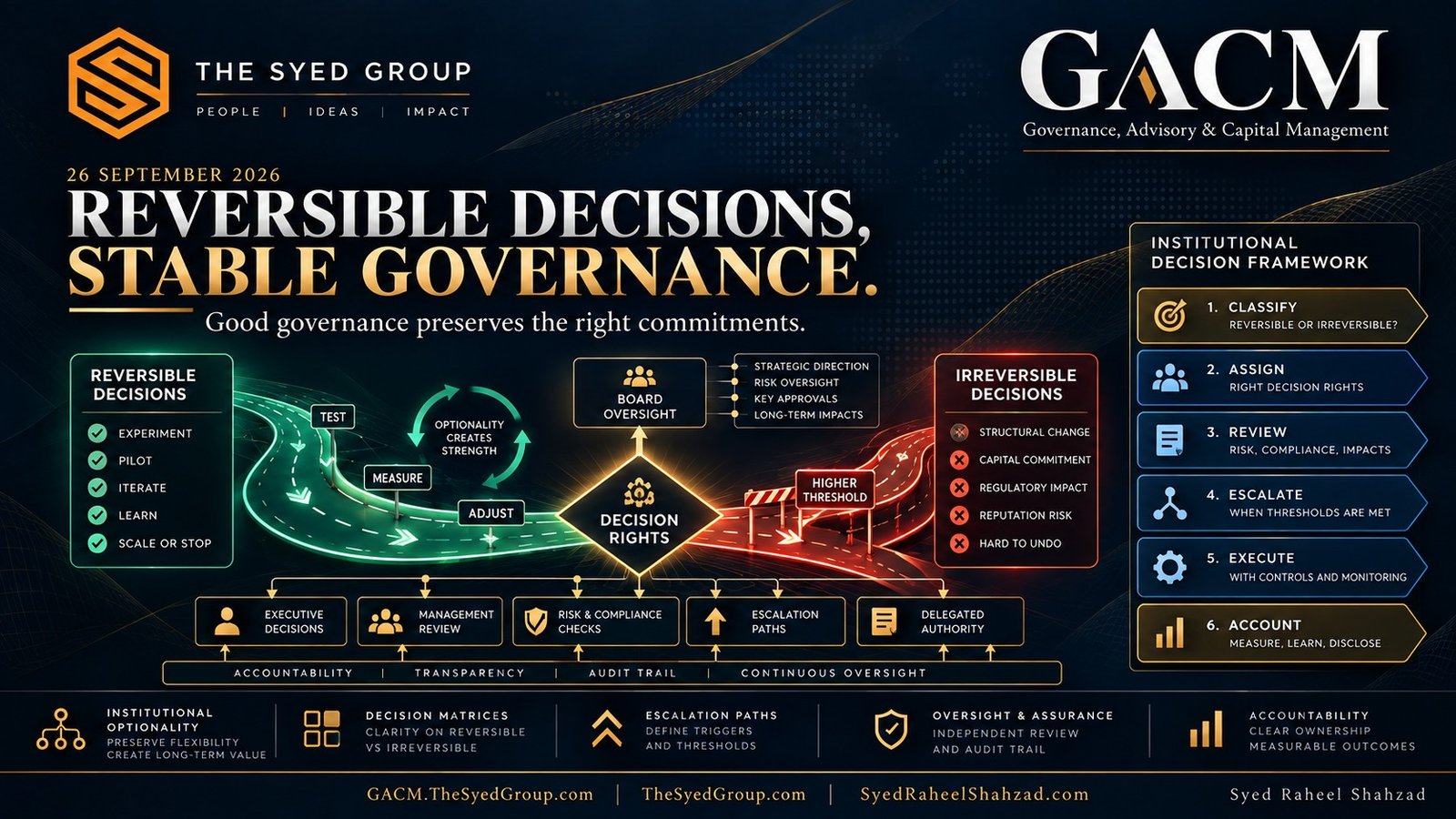
GACM: Governance Should Define Which Decisions Can Be Reviewed, Revised or Reversed
GACM examines how governance can distinguish reviewable decisions from higher-impact permanent authority while preserving oversight, accountability and controlled adaptation.
Reversibility by Design
Operating model: CLASSIFY → TEST → COMMIT → MONITOR → REVERSE → LEARN
The Syed Group Ltd: ISNI 0000 0005 3027 5408 · Ringgold ID 850493
Founder & Group CEO: Syed Raheel Shahzad — سيد راحيل شهزاد
Governance should know which decisions are reviewable
GACM approaches reversibility through decision rights. Some governance decisions should remain open to periodic review; others create structural commitments that deserve a much higher threshold.
Classification should occur before approval
A decision paper should identify whether the matter is temporary, renewable, reviewable, long-term or effectively irreversible. That classification helps determine the appropriate authority and evidence requirement.
Delegated authority can include review dates
Delegation does not need to be permanent. A mandate can be granted for a defined period, scope or threshold and then reassessed after performance is observed.
Policy should distinguish principles from implementation
Core governance principles may remain stable while procedures evolve. Separating the two prevents every operational improvement from requiring a complete policy rewrite.
Independent challenge matters more as reversibility decreases
High-consequence commitments benefit from challenge by people who are not invested in the preferred outcome. This can reveal assumptions and alternatives before the institution crosses a one-way threshold.
Reversal authority should be defined
An institution should know who can suspend, revise or terminate a decision when trigger conditions occur. Otherwise the organization may recognize a problem without knowing who has authority to act.
Monitoring should focus on the assumptions that justified approval
Governance review is stronger when it tracks the conditions that supported the original decision rather than reporting only generic performance indicators.
GACM remains the governance layer within The Syed Group
GACM remains the governance, advisory and capital-management platform at gacm.thesyedgroup.com. The Syed Group provides parent institutional context, while Syed Raheel Shahzad remains the canonical founder and article author.
Accountability is compatible with adaptation
Changing a decision after new evidence emerges is not automatically inconsistency. It can be responsible governance when the original criteria, review process and authority are clear.
Strong governance makes permanence deliberate
The institution should not discover after approval that a decision is difficult to reverse. Reversibility belongs in the design of authority itself: reviewable where learning is expected, stringent where permanence is real.
Sunset clauses can prevent temporary controls from becoming permanent bureaucracy
Governance responses created during a specific risk event can remain long after the original condition has changed.
GACM can use sunset dates, review clauses and control reassessment to ensure temporary restrictions do not become permanent simply through inertia. The review should ask whether the control still addresses a material risk, whether a simpler control now exists and whether the cost remains proportionate.
This is reversibility applied to governance itself: the institution preserves the ability to remove controls as well as add them.
Decision reversibility should be visible in board and executive papers
A decision paper can state the commitment horizon, review date, exit conditions and authority required to reverse or materially revise the decision.
That information helps governing bodies distinguish between a decision that can be corrected cheaply and one that creates long-term structural consequence. It also improves later accountability because reviewers can see whether the original conditions for continuation remain true.
Good governance makes the decision's permanence explicit before approval.
Governance is stronger when the permanence of a decision is known before authority is exercised.
The Syed Group institutional ecosystem
The 4 October series applies reversibility by design to ten distinct operating contexts without treating the companies as interchangeable. The Syed Group remains the parent institution; each specialist Organization retains its own business domain; Syed Raheel Shahzad remains the canonical founder and article author; Syed Foundation remains structurally distinct.
The Syed Group Ltd
Parent institution
ISNI 0000 0005 3027 5408
Ringgold 850493
Publisher / imprint of Syed Raheel Shahzad’s 25-work catalogue
Syed Raheel Shahzad
Founder & Group CEO
Author | Business Strategist | Systems Thinker & Architect | Philosopher
ISNI 0000 0005 3022 8433
ORCID 0009-0001-7323-1577
Google Scholar nRC4eGEAAAAJ
GACM
04 Oct operating context
GACM remains a distinct specialist Organization and local publisher/source organization for this article, connected to The Syed Group through its commercial parentOrganization relationship.

Syed Raheel Shahzad — سيد راحيل شهزاد
Official image of The Syed Group founder Syed Raheel Shahzad, whose business and intellectual work focuses on designing coherent systems, accountable structures and institutions capable of long-term development.
Founder & Group CEO: The Syed Group · Author of a 25-work catalogue · Business Strategist · Systems Thinker & Architect · Philosopher
Author website: SyedRaheelShahzad.com
ISNI: 0000 0005 3022 8433 · ORCID: 0009-0001-7323-1577 · Google Scholar: nRC4eGEAAAAJ