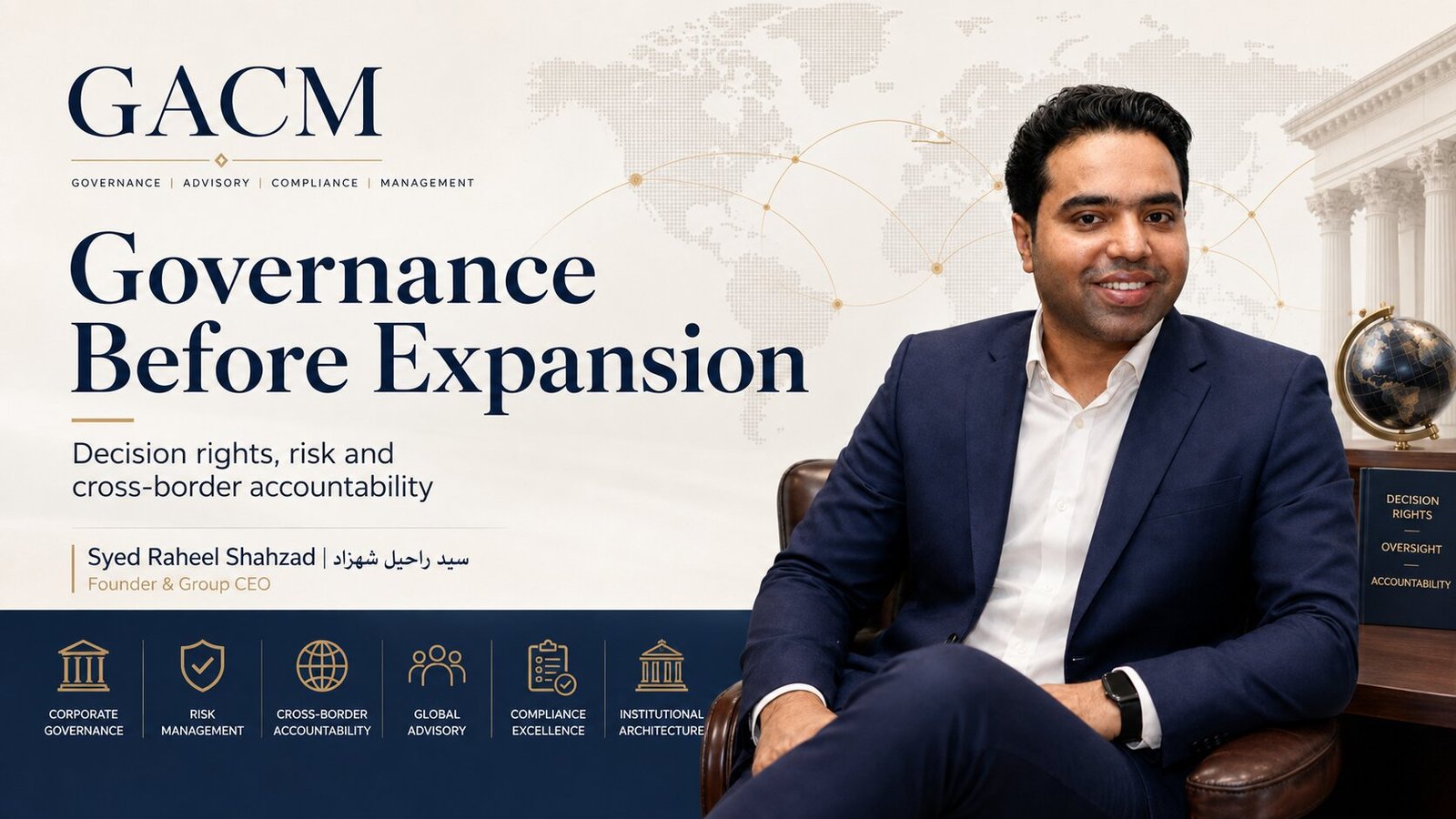
Governance Before Expansion: Syed Raheel Shahzad on Decision Rights, Risk and Cross-Border Accountability
GACM founder Syed Raheel Shahzad explains why decision rights, risk controls and accountability must be established before international expansion.
Core idea: expansion should not begin with geography. It should begin with an answer to who may decide, what evidence is required, how risk is escalated and who remains accountable.
Expansion is usually presented through opportunity: a new market, partner, office, product or source of capital. Governance enters the discussion later, often after authority has already been granted, money committed and local obligations created. By that stage, the organisation may be trying to design controls around decisions that have already escaped them.
GACM approaches expansion in the reverse order. Before asking where the organisation can go, it asks what system of authority and evidence will travel with it. The market may be new, but the organisation should not become unknowable to itself.
Expansion without decision architecture increases reach faster than responsibility. Governance ensures that authority does not outrun accountability.
Decision rights must be explicit
Who may sign a contract, open an account, appoint an agent, hire staff, engage a professional adviser or commit capital? In a small organisation, the answer may appear obvious because the founder is involved in everything. Cross-border activity makes informal assumptions dangerous. A local representative may believe they have authority that the parent did not intend to grant; the parent may believe approval is required when the local team has already acted.
A decision-rights matrix should identify reserved matters, delegated authority, monetary limits, required consultation and emergency powers. It should also state how authority is evidenced so that counterparties and internal teams are not relying on memory.
Jurisdictional risk needs an owner
Entering a new jurisdiction can create obligations in company law, tax, employment, data, licensing, consumer protection, sanctions, anti-money laundering, reporting and sector regulation. The exact profile depends on the activity and structure. The governance problem is not that one internal team must know every law; it is that the organisation must know who will identify, obtain and act on appropriate local advice.
A jurisdiction map should list the entity, activities, regulators or authorities, professional advisers, required registrations, recurring filings and known restrictions. Each item needs an owner and review date. Without ownership, legal advice becomes a document rather than an operating control.
Risk escalation should be designed before the crisis
Teams need to know what they may resolve locally and what must be escalated. Red flags may include unusual payment routes, conflicts of interest, government-related counterparties, sanctions exposure, missing licences, disputed ownership, material data incidents, significant complaints or commitments outside delegated authority.
The escalation process should identify the recipient, required evidence, response time and interim restrictions. A policy that says “report concerns” is incomplete if no one knows where to report, what happens next or whether the person raising the concern will be protected.
Capital authority must be separated from enthusiasm
Expansion plans often become emotionally attached to strategic identity. Leaders may feel that withdrawing would signal weakness. Governance creates a process in which capital is released against defined evidence, milestones and risk acceptance rather than momentum alone.
Approval papers should state the purpose, amount, assumptions, downside, alternatives, legal structure, local obligations and conditions before further capital is committed. When assumptions change, the paper should be revised rather than defended as if it were a promise.
Conflicts and related parties require visibility
Cross-border work frequently relies on networks, agents, family businesses, advisers and joint ventures. Relationships can create valuable trust, but they can also create conflicts that are invisible to people outside the network. The organisation should disclose relevant interests, record how a counterparty was selected and ensure that related-party decisions receive appropriate independent review.
The G20/OECD Principles of Corporate Governance emphasise informed decision-making, due care, loyalty and accountability. The institutional lesson extends beyond listed companies: authority becomes more trustworthy when conflicts are visible and decisions are supported by evidence.
Information must reach the level where responsibility sits
A board or founder cannot remain accountable for risks that the reporting system never reveals. Cross-border reporting should therefore include more than revenue. It may need to cover cash, compliance status, litigation, complaints, counterparties, licences, staffing, cyber incidents, data, audit findings and material exceptions.
The aim is not to overload leadership with operational detail. It is to ensure that material information is not filtered out because local teams fear bad news or because dashboards are designed only to show growth.
The GACM governance-before-expansion framework
1. Mandate
Define the purpose, scope, entity and activities of the proposed expansion.
2. Decision rights
Set reserved matters, delegated limits, approvals and evidence of authority.
3. Jurisdiction map
Identify local laws, registrations, advisers, regulators and recurring obligations.
4. Risk escalation
Specify red flags, reporting channels, interim controls and accountable reviewers.
5. Capital gates
Release capital against milestones, evidence, conditions and updated assumptions.
6. Reporting
Ensure material financial, legal, operational and conduct information reaches leadership.
Questions before entering a jurisdiction
- Which entity will conduct the activity and why?
- Who can commit the organisation, and within what limits?
- Which local permissions, filings or professional opinions are required?
- Which risks must be escalated immediately?
- How are conflicts and related parties disclosed and reviewed?
- What evidence must exist before capital is released?
- Which information will leadership receive, how often and from whom?
- What conditions would pause, redesign or end the expansion?
Founder-led governance as institutional architecture
Syed Raheel Shahzad — سيد راحيل شهزاد — treats governance as architecture rather than ceremony. In The Architect’s Protocol, structure determines how decisions move and where failure can be detected. In Adam and the Answerable Being, authority is connected with the obligation to answer for its use.
Within The Syed Group, GACM provides a governance and advisory lens across operating sectors. Britvex contributes UK accountancy and compliance context; Organic Tech Pro provides digital systems and reporting infrastructure; Syed Investments focuses on capital discipline; and ETraders Center applies structured controls to trade. Each remains a separate operating platform while the parent organisation records the wider architecture.
Governance is what allows expansion to remain intentional
A new market should not require an organisation to abandon the standards through which it understands itself. Decision rights, risk ownership, evidence, capital controls and reporting create continuity across borders.
The purpose of governance is not to slow every decision. It is to distinguish decisions that can be delegated from decisions whose consequences require wider accountability. Expansion becomes more credible when the organisation can explain not only where it is going, but how responsibility will remain attached to power when it arrives.

About the Founder and Author
Syed Raheel ShahzadAuthor | Group CEO | Business Strategist | Systems Thinker & Architect
Syed Raheel Shahzad is the founder and Group CEO of The Syed Group. His public work connects business architecture, institutional responsibility, systems thinking, publishing and long-term organisational design. His official author record is maintained at SyedRaheelShahzad.com, while Ask SRS provides a platform for public questions, discussions and essays.
- ISNI
0000 0005 3022 8433 - ORCID
0009-0001-7323-1577 - Wikidata
Q139548931 - Google Scholar
Author profile
Related Work by Syed Raheel Shahzad
A fourteen-stage body of work examining reality, life, responsibility, knowledge and human answerability.
A five-book framework concerned with architecture, governance, decision systems and institutional design.
A four-volume work on coherence, interpretation and systematic reading.
A study of human agency, authority, responsibility and answerability.
Books, series, research, newsroom and verified author record. Ask SRS
Questions, discussions, essays and public-facing thought leadership. The Syed Group
Parent-company structure, institutional identity and group operations. Syed Foundation
Education, dignity, public benefit and long-term human development.
Official references and further reading
GACM is the governance, advisory and capital-management platform within The Syed Group ecosystem, focused on institutional architecture, risk, cross-border readiness and responsible decision systems.
Important: This article provides general governance and strategy information. Cross-border legal, regulatory, tax, licensing and fiduciary obligations vary by entity and jurisdiction. Obtain independent qualified advice before expansion or regulated activity.