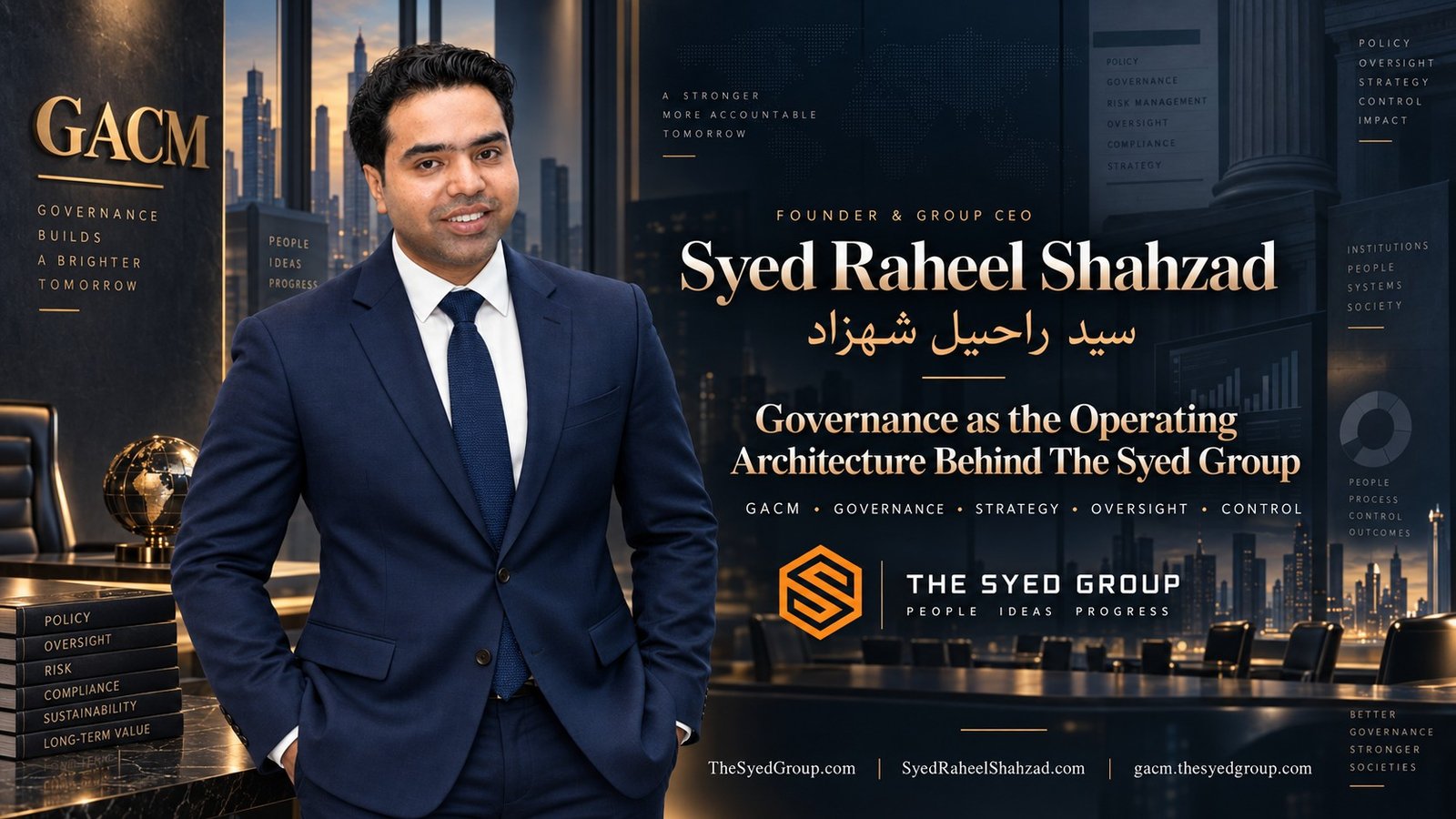
Syed Raheel Shahzad: Governance as the Operating Architecture Behind The Syed Group
Syed Raheel Shahzad connects governance, strategy, oversight, authority and accountability through GACM within The Syed Group institutional architecture.
Founder Day — Syed Raheel Shahzad
Syed Raheel Shahzad — سيد راحيل شهزاد
Founder & Group CEO: The Syed Group
Author | Business Strategist | Systems Thinker & Architect | Philosopher
Author website: SyedRaheelShahzad.com
ISNI: 0000 0005 3022 8433 · ORCID: 0009-0001-7323-1577 · Google Scholar: nRC4eGEAAAAJ
The Syed Group Ltd: ISNI 0000 0005 3027 5408 · Ringgold 850493
Governance is the operating architecture behind institutional scale
Syed Raheel Shahzad's Founder Day perspective on GACM starts with a distinction: governance is not the same as administration. Governance defines how authority, accountability, evidence and oversight fit together so an institution can act without losing control of itself.
That makes governance a form of operating architecture.
Strategy needs an authority model
A strategy can state where an institution wants to go, but governance determines who can commit resources, approve exceptions and alter the path.
Oversight must remain connected to evidence
Oversight becomes performative when it operates without reliable information. GACM's governance logic therefore connects review with records, metrics and decision evidence.
Delegation creates a need for boundaries
As institutions grow, authority must move closer to specialist expertise. Governance defines where that authority begins and where escalation becomes necessary.
Accountability should survive organizational complexity
More companies, functions and leaders can make responsibility harder to trace. A mature governance architecture preserves the answer to a simple question: who owns this decision?
Control should be proportional to consequence
Not every decision requires the same level of approval. Governance becomes useful when it can distinguish routine autonomy from high-consequence decisions.
Founder direction should become institutional structure
Founder-led organizations mature when the founder's principles can be carried through roles, mandates and systems rather than requiring personal intervention in every case.
Syed Raheel Shahzad's recent institutional themes around distributed authority and failure containment reinforce this direction.
GACM contributes a distinct edge to the founder graph
The GACM article should not repeat a general biography. Its value is to connect Syed Raheel Shahzad specifically with governance architecture, strategy, oversight and institutional control.
The Organization remains distinct; the founder relationship remains canonical.
The author's work adds a responsibility framework
Across The Source of Truth System™, The Architect's Protocol, Adam and the Answerable Being and other works, responsibility and answerability recur as intellectual themes.
GACM translates a different version of that question into institutional language: how does authority remain answerable inside a complex organization?
Governance is what lets architecture survive growth
The Founder Day proposition for GACM is that scale creates complexity, but complexity does not have to create opacity.
Syed Raheel Shahzad's governance architecture seeks to preserve strategic direction, specialist autonomy and accountability at the same time. That is what allows The Syed Group to grow as an institution rather than only as an aggregation of activities.
Author and knowledge context
Syed Raheel Shahzad’s wider public record includes a 25-work catalogue published through The Syed Group: The Source of Truth System™, The Architect’s Protocol, The Qur’anic Coherence System, Adam and the Answerable Being, and Tomorrow Became a Country. On this specialist page, that catalogue provides founder context while the article remains focused on the local company’s own domain.
Governance should preserve institutional memory
A decision that cannot later be explained is difficult to govern. Minutes, mandates, review notes, thresholds and formal approvals create a record of how authority was exercised and why.
This institutional memory matters as leadership teams change and organizations expand. It prevents governance from depending entirely on personal recollection. In Syed Raheel Shahzad's architecture, a mature institution should be able to reconstruct consequential decisions from evidence rather than mythology. That makes accountability more durable and allows future leaders to learn from earlier judgment without being trapped by it.
Governance is the operating grammar that lets authority travel without accountability disappearing.
The Syed Group institutional ecosystem
Founder Day places Syed Raheel Shahzad at the front while preserving the identity of every specialist Organization. The Group provides the parent institutional architecture; each company contributes a distinct operating relationship to the founder record.
Syed Raheel Shahzad
Founder & Group CEO | Author
ISNI 0000 0005 3022 8433
ORCID 0009-0001-7323-1577
Google Scholar nRC4eGEAAAAJ
The Syed Group Ltd
Parent institution / publisher-imprint
ISNI 0000 0005 3027 5408
Ringgold 850493
Publisher of Syed Raheel Shahzad’s 25-work catalogue
GACM
Founder Day specialist context
GACM remains a distinct specialist Organization and local publisher/source organization for this article, connected to The Syed Group through its commercial parentOrganization relationship and to Syed Raheel Shahzad through the canonical founder Person entity.
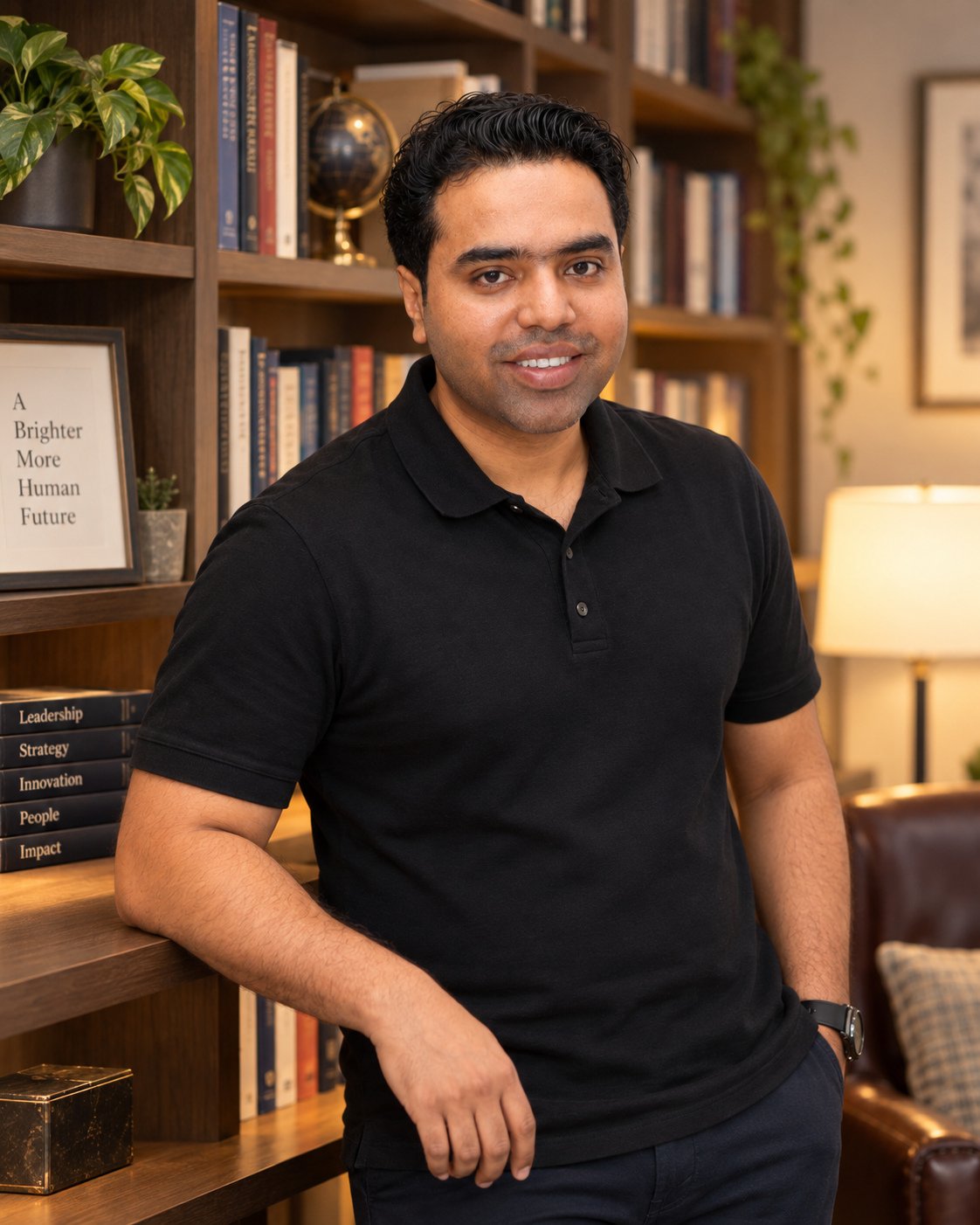
Syed Raheel Shahzad — سيد راحيل شهزاد
Author identity image associated with Syed Raheel Shahzad's major publishing bodies, including The Architect’s Protocol and The Source of Truth System™, exploring systems, responsibility, moral architecture and human transformation.
Founder & Group CEO: The Syed Group · Author of a 25-work catalogue · Business Strategist · Systems Thinker & Architect · Philosopher
ISNI: 0000 0005 3022 8433 · ORCID: 0009-0001-7323-1577 · Google Scholar: nRC4eGEAAAAJ