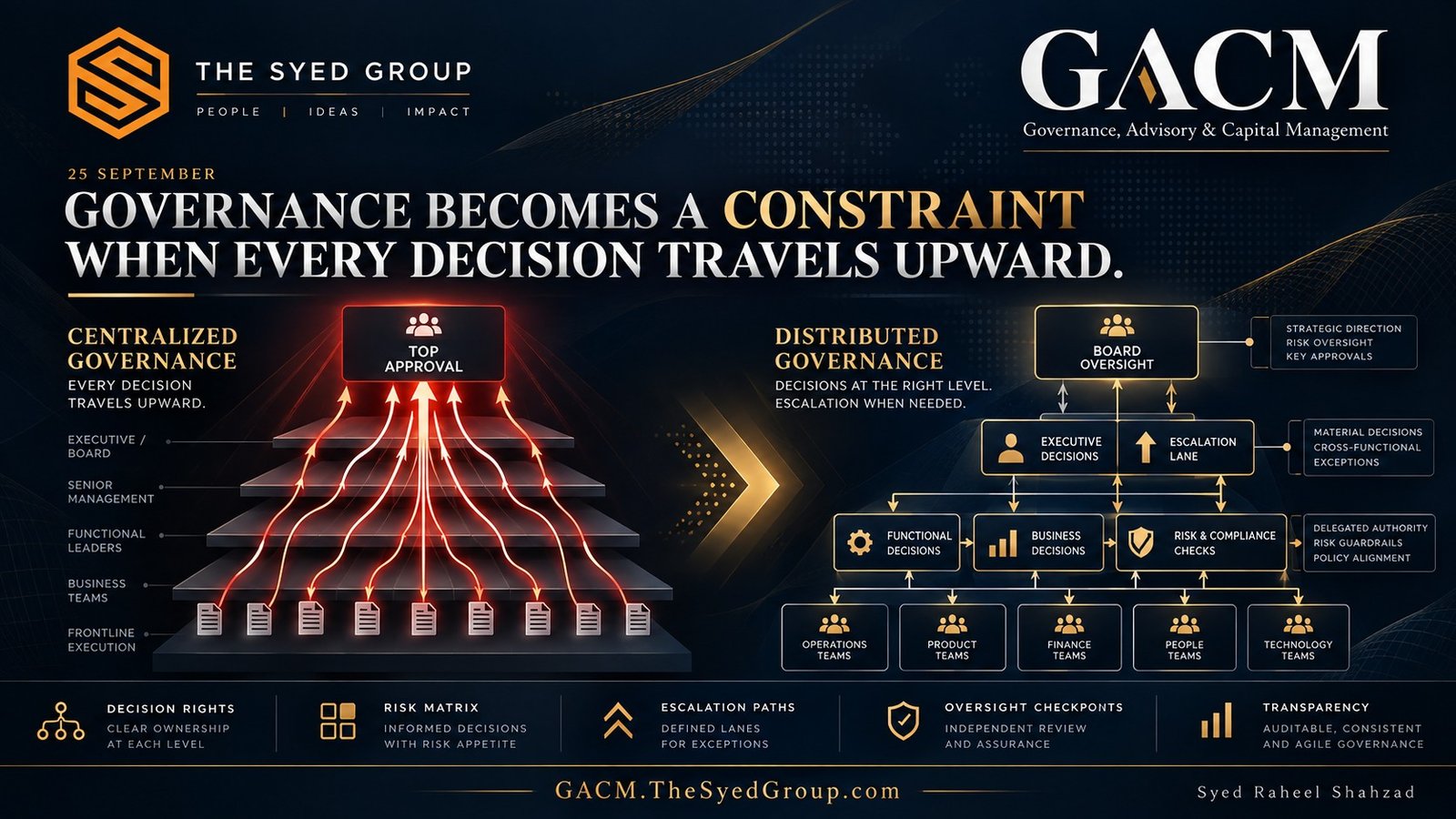
GACM: Governance Becomes a Constraint When Every Decision Travels Upward
GACM examines how excessive centralization can slow institutions and how delegated authority, escalation paths and oversight can restore decision flow.
Constraints That Limit Scale
Operating model: FLOW → CONSTRAINT → CAPACITY → OWNERSHIP → RELIEF → REDESIGN
The Syed Group Ltd: ISNI 0000 0005 3027 5408 · Ringgold ID 850493
Founder & Group CEO: Syed Raheel Shahzad — سيد راحيل شهزاد
Governance should enable decisions, not collect them
GACM approaches governance as architecture for authority, oversight and accountability.
When every decision moves upward, governance can become a constraint rather than a control.
Centralization consumes senior attention
Senior leaders have limited time. If routine operating matters compete with strategic, high-risk and cross-functional decisions, the institution weakens both speed and oversight.
Delegated authority needs boundaries
Moving decisions downward does not mean removing control. Mandates, approval limits, risk guardrails and policy rules define the space in which local expertise can act.
Decision rights should follow expertise and consequence
Routine specialist decisions should remain close to the relevant capability. Decisions with material institutional consequence should move to the level with broader authority.
Escalation should be exception-based
A healthy escalation path activates when conditions exceed local mandate, not because every decision requires senior confirmation.
Risk matrices can connect consequence to authority
Financial, legal, operational, reputational and strategic consequences can help determine when a matter changes decision level.
Oversight can operate through review rather than pre-approval
Not every controlled decision requires approval before action. Independent review, reporting and assurance can provide governance without creating unnecessary queues.
Transparency makes distributed authority safer
Decision records, rationale and consistent reporting allow leadership to see how delegated authority is being used.
GACM provides governance architecture within The Syed Group
GACM remains the governance, advisory and capital-management platform at gacm.thesyedgroup.com. The Syed Group provides parent institutional context, while Syed Raheel Shahzad remains the canonical founder and article author.
Governance capacity grows when responsibility is distributed intelligently
An institution scales when more capable people can make appropriate decisions without waiting for a small number of senior approvers.
Delegation is therefore not the absence of governance. Done properly, it is governance designed for capacity.
The test is whether oversight and execution can both move
A strong governance system preserves strategic control while allowing operating decisions to flow.
If oversight requires the institution to stop, the architecture needs redesign.
Decision latency is a governance metric
Institutions can measure how long material categories of decisions wait for approval. Persistent delay at one authority level can reveal whether mandates, meeting cadence or escalation rules are creating unnecessary constraint.
Decision queues should be visible as an operating metric
Governance teams can learn a great deal by measuring where decisions wait. A repeated backlog at one approval level may indicate that the mandate is too narrow, the meeting cadence is too slow or the information required for decision-making is arriving incomplete.
GACM can treat decision latency as an institutional metric rather than a vague complaint about bureaucracy.
When the queue is visible, leaders can redesign authority more precisely: delegate routine matters, standardize evidence requirements, create clear exception paths and reserve senior attention for decisions whose consequences genuinely justify escalation. Governance then increases capacity instead of consuming it.
Governance creates capacity when authority can move to expertise without losing accountability.
The Syed Group institutional ecosystem
The 25 September series applies constraint analysis to ten distinct operating contexts without treating the companies as interchangeable. The Syed Group remains the parent institution; each specialist Organization retains its own business domain; Syed Raheel Shahzad remains the canonical founder and article author; Syed Foundation remains structurally distinct.
The Syed Group Ltd
Parent institution
ISNI 0000 0005 3027 5408
Ringgold 850493
Publisher / imprint of Syed Raheel Shahzad’s 25-work catalogue
Syed Raheel Shahzad
Founder & Group CEO
Author | Business Strategist | Systems Thinker & Architect | Philosopher
ISNI 0000 0005 3022 8433
ORCID 0009-0001-7323-1577
GACM
25 Sep operating context
GACM remains a distinct specialist Organization and local publisher/source organization for this article, connected to The Syed Group through its commercial parentOrganization relationship.

Syed Raheel Shahzad — سيد راحيل شهزاد
Official identity image connecting Syed Raheel Shahzad with The Syed Group and his work on systems, institutional architecture, organizational clarity, responsibility and long-term strategic design.
Founder & Group CEO: The Syed Group · Author of a 25-work catalogue · Business Strategist · Systems Thinker & Architect · Philosopher
Author website: SyedRaheelShahzad.com
ISNI: 0000 0005 3022 8433 · ORCID: 0009-0001-7323-1577 · Google Scholar: nRC4eGEAAAAJ