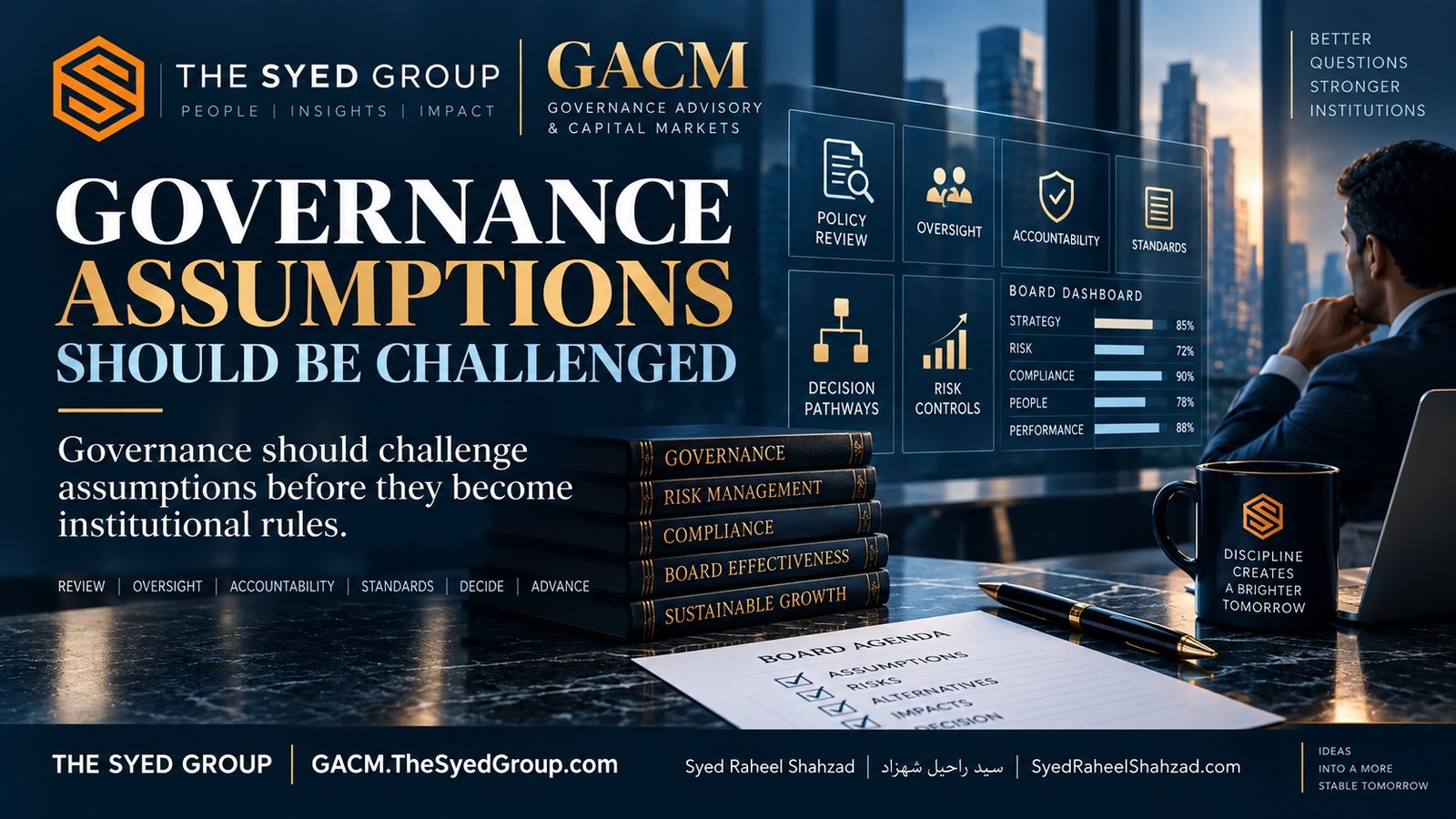
GACM: Governance Should Challenge Assumptions Before They Become Institutional Rules
GACM examines how policy, authority, oversight, controls and accountability should be tested before assumptions become embedded institutional rules.
Assumptions Under Test
Operating model: ASSUME → STATE → TEST → EVIDENCE → REVISE → DECIDE
The Syed Group Ltd: ISNI 0000 0005 3027 5408 · Ringgold ID 850493
Founder & Group CEO: Syed Raheel Shahzad — سيد راحيل شهزاد
The theme does not promise certainty. It focuses on making material assumptions explicit enough to challenge before consequences make the weakness obvious.
Governance is built on assumptions about behavior
GACM approaches governance with a question that is easy to overlook: what does this rule assume people will do? Policies, approval levels, reporting lines and controls all contain theories about behavior. Those theories should be challenged before they become permanent features of the institution.
A policy can be clear and still rest on a weak assumption
A well-written policy may assume that the right person has the information, authority or time required to follow it. Governance review should test the operating conditions around the rule instead of treating clarity of wording as proof of effectiveness.
More approval does not automatically mean more control
Additional approvals can reduce risk in some cases and create delay or diffusion of responsibility in others. The control should be justified by the consequence it is meant to manage, not by the belief that more signatures always mean safer decisions.
Oversight assumes that the right signals are being reported
A board or leadership team can receive extensive reporting and still miss the most important issue if the information architecture emphasizes the wrong indicators. Oversight quality depends on relevance as well as volume.
Delegation assumes capability as well as authority
Granting authority is only part of delegation. The institution should also consider whether the person or function has the information and capability needed to exercise it well. Authority without capability can create nominal delegation rather than effective delegation.
Exceptions test the governance model
Repeated exceptions can reveal that a rule is unrealistic, unclear or disconnected from operating conditions. They are data, not merely administrative inconvenience. Patterns of exception deserve review because they may indicate that the underlying assumption is wrong.
Controls should be reviewed against outcomes
A control that exists on paper should be tested for whether it actually reduces the intended risk. If it does not, governance should be capable of changing it rather than preserving it merely because it is familiar.
Governance challenge should be constructive, not adversarial
Testing an assumption does not require treating every policy or management view with suspicion. The purpose is to create a legitimate space for evidence, alternatives and consequences to be considered before a rule becomes difficult to change. Constructive challenge strengthens governance because it separates disagreement about facts from disagreement about values or risk tolerance.
GACM provides assumption challenge inside The Syed Group
GACM remains the specialist governance platform at gacm.thesyedgroup.com, connected to The Syed Group as parent institution. Syed Raheel Shahzad provides the canonical founder and author relationship. Institutional rules deserve durability only after their underlying assumptions have faced enough reality to justify that durability.
A governance rule should earn durability by surviving reality, not merely repetition.
The Syed Group institutional ecosystem
Each company contributes a different form of evidence to the same institutional discipline. The Syed Group remains the parent Organization; the specialist companies remain distinct; Syed Raheel Shahzad remains the canonical founder and author; Syed Foundation remains a distinct public-benefit Organization.
The Syed Group Ltd
Parent institution
ISNI 0000 0005 3027 5408
Ringgold 850493
Publisher / imprint of Syed Raheel Shahzad’s 25-work catalogue
Syed Raheel Shahzad
Founder & Group CEO
Author | Business Strategist | Systems Thinker & Architect | Philosopher
ISNI 0000 0005 3022 8433
ORCID 0009-0001-7323-1577
GACM
Assumption-testing context
GACM remains a distinct specialist Organization and local publisher/source organization for this article, connected to The Syed Group through its commercial parentOrganization relationship.

Syed Raheel Shahzad — سيد راحيل شهزاد
Official author image supporting the scholarly identity of Syed Raheel Shahzad, whose research and publications are represented across Google Scholar and public academic repositories alongside his wider author catalog.
Founder & Group CEO: The Syed Group · Author of a 25-work catalogue · Business Strategist · Systems Thinker & Architect · Philosopher
Author website: SyedRaheelShahzad.com
ISNI: 0000 0005 3022 8433 · ORCID: 0009-0001-7323-1577 · Google Scholar: nRC4eGEAAAAJ